Disclosure
CarmaOne publishes this list, and we ranked ourselves first. We explain why below, and we have tried to describe every other provider fairly using only what each company states on its own website or in reputable press coverage. Capabilities, coverage and turnaround figures are the vendors' own claims, not independent audits. Please check each vendor's site and ask for references before you decide. Last reviewed November 2026.
Almost every retail and MSME loan in India still depends on one question that no bureau report can fully answer: does this person actually live and work where the application says they do? That is the job of Contact Point Verification (CPV), and choosing who does it for you is one of the most consequential vendor decisions a credit or operations head makes.
The market has changed. A few years ago, "CPV vendor for NBFC" meant a set of local agencies empanelled city by city. In 2026, lenders choose between three broad models: managed field agencies that send people to the door, digital verification platforms that verify addresses and contact points remotely through APIs, video and data, and hybrid providers that combine an app, an allocation engine and a field network. This guide ranks the companies we think lenders should shortlist, and explains which model each one fits.
If you are new to the topic, start with What is CPV in loans. If you are weighing agencies against software in principle, read CPV agency vs digital CPV platform. This article is about specific providers.
How We Evaluated CPV and Field Verification Providers
We looked only at companies whose official website or reputable press coverage explicitly mentions contact point, field or address verification for banks, NBFCs, fintechs or other BFSI clients. Employment background-check firms whose address checks are built mainly for hiring were left out, even where they are well known. For each provider we considered:
- Model: managed field agency, digital platform or hybrid.
- Coverage as stated: the pin-code or geographic reach the company itself publishes.
- Digital evidence: geo-tagging, timestamps, live photo capture, liveness or face match.
- BFSI focus: whether lending is a core use case or one of many.
- Integration: whether reports can flow into a loan origination system (LOS) or credit workflow by API.
We did not compare pricing. CPV is almost always quoted per case and depends on check type, location category and TAT, so any published number would mislead.
At a Glance: CPV and Field Verification Providers Ranked
| Rank | Company | Type | Coverage (as stated) | Digital Evidence | BFSI Focus | Integration | Best For |
|---|---|---|---|---|---|---|---|
| #1 | CarmaOne | Hybrid (platform + managed field network) | 22+ states, 14,000+ pin codes | Geo-tagged visits, live-only photos, liveness and face match, GPS match to address | Core: lending, underwriting and collections | Triggered from LOS or API; report posted back to LOS | Lenders wanting CPV inside underwriting and collections |
| #2 | AuthBridge (GroundCheck.ai) | Hybrid (white-label app, hybrid or fully managed) | 20,000+ PIN codes (per press) | Geo-tagged reports, liveness, face match, shopfront identification | BFSI, fintech, insurance, logistics | Dashboards, GPS-coded reports | Large lenders wanting deployment flexibility |
| #3 | OnGrid | Hybrid (field network + API) | 18,000+ pin codes | Geo-location tagging | Banks, NBFCs, fintechs, card issuers | API integration with lending systems | Lenders wanting published tier-wise TATs |
| #4 | Manipal Business Solutions | Managed field agency (tech-enabled) | 10,000+ pin codes | GPS tagging, timestamped records | Financial institutions (CPV, FI, doorstep KYC) | API integrations | Banks wanting CPV, FI and doorstep services from one vendor |
| #5 | IDfy | Digital-first with physical fallback | Not stated as pin-code count; 1,000+ runners | Geo-tagging, live image capture, video-based document checks | Broad: KYC, lending, payments, BGV | APIs and platform | Lenders already using IDfy for KYC |
| #6 | Surepass | Digital platform (CPV API) | Remote; no field coverage stated | Risk score and audit-ready CPV report | Banks, NBFCs, fintechs, insurers | API, bulk batch processing | Low-ticket digital loans as a first filter |
| #7 | Signzy (Video KYC) | Digital platform (adjacent: V-CIP) | Remote | Live location capture, liveness, face match, VPN and IP spoofing checks | Banks, NBFCs, financial services | APIs | Remote identity and location checks, not a CPV substitute |
Three Models: Managed Agency, Digital Platform or Hybrid
Before comparing names, decide which model you are buying. The three are not interchangeable.
- Managed field agencies send a trained executive to the residence or office and return a report. This is the classic field investigation and residence verification model. Its strength is physical evidence; its weakness, historically, has been inconsistent quality and reports that arrive as PDFs or emails outside your systems.
- Digital verification platforms confirm contact points remotely, using data cross-checks, video calls, location capture or tele-verification. They are fast and cheap per case but do not put eyes on a doorway, which matters for higher-ticket, self-employed and MSME files.
- Hybrid providers run a verification app and allocation engine on top of a field network, so every physical visit produces digital evidence (geo-tags, timestamps, live photos) and a structured report that can flow back into the LOS. Most lenders that have modernised CPV have moved here.
Most lenders end up with a risk-based mix: a digital or tele check for low-risk files, a physical CPV for the rest, and a deeper field investigation for high-ticket or doubtful cases.
1. CarmaOne: CPV Built Into Underwriting and Collections
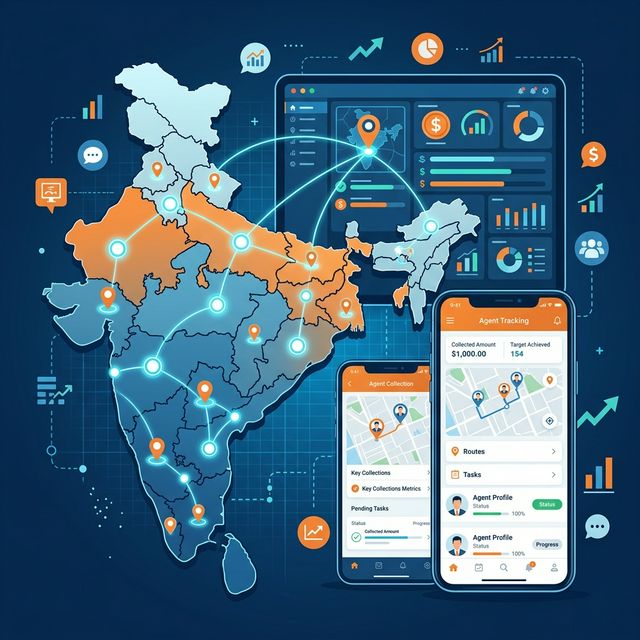
We ranked CarmaOne CPV verification first because it treats CPV as a step inside the credit workflow, not a separate outsourced errand. A CPV request is raised from the LOS or through an API when an application reaches the verification stage, so applicant details travel with the case and nobody re-keys data. The case is routed to a field executive mapped to that pin code, and the visit is captured in a mobile app that records GPS coordinates and timestamps and compares the capture location with the declared address, so a desk-filled or proxy visit is flagged.
Photos are taken live inside the app with gallery uploads blocked, and where the applicant consents, liveness and face-match checks help confirm that the person met is the person who applied. The final report, with a positive, negative or refer-to-credit outcome, observations, photos and geo-coordinates, lands back in the lender's LOS or dashboard.
The field network is the same pan-India network that CARMA Recover uses for field collections, spanning 22+ states and 14,000+ pin codes. That matters for two reasons: the lender deals with one partner from verification through to recovery, and CPV evidence can be read alongside GST, bureau and bank-statement analysis in CARMA Assess for credit underwriting. Rather than quote one national TAT, CarmaOne agrees TAT by pin-code cluster before go-live and tracks every case against it.
Consider alternatives if: you only need a one-off remote address check with no physical visit, or you already have a large in-house field team and only want an app. In that case, a white-label option such as AuthBridge's may suit you better.
2. AuthBridge (GroundCheck.ai): The Most Flexible Deployment Options
AuthBridge is one of India's best-known verification companies, and in June 2025 it launched GroundCheck.ai, which it describes as an AI-powered Contact Point Verification platform, according to coverage in CXOToday. Per that report, the platform can be deployed three ways: a white-labelled app for clients using their own field agents, a hybrid model that uses AuthBridge's trained field force, and a fully managed service run end-to-end by AuthBridge. Reported features include risk-tiered workflows, address triangulation, liveness checks, shopfront identification, AI-based case assignment and geo-tagged, auditable reporting, with coverage of 20,000+ PIN codes.
AuthBridge's website also lists field verification services covering address existence, business ownership and line-of-business identification, with live image capture, geo-tagging and timestamping. Best for: large banks and NBFCs that want to choose between running their own agents and outsourcing. Ask about: how reports reach your LOS, and TAT by location tier.
3. OnGrid: Published Tier-Wise Turnaround Times
OnGrid is better known for background verification, but its website describes a dedicated Contact Point Verification and Field Audit offering for lenders and says it is trusted by banks, NBFCs, fintechs and credit card issuers. According to its website, it covers 18,000+ pin codes pan-India, offers API integration with lending systems, and lists address verification with geo-location tagging among its verification types. Gridlines is OnGrid's API brand for verification workflows.
Unusually, OnGrid publishes indicative TATs: same-day in metros, 24 hours for Tier I, 48 hours for Tier II and 72 hours for Tier III locations, per its website. Best for: fintechs and NBFCs that want an API-first vendor with stated tier-wise TAT. Ask about: how those TATs are measured and what happens when a case is untraceable.
4. Manipal Business Solutions: A Bank-Focused Field Services Specialist
Manipal Business Solutions (MBS) positions itself as a services partner to financial institutions, offering doorstep KYC and re-KYC, field verification and customer onboarding alongside CPV and field investigation. According to its website, its CPV service uses GPS-enabled verification for residential and business addresses, produces timestamped verification records, supports API integration, and covers over 10,000 pin codes across urban, suburban and rural areas through an on-ground network.
Best for: banks that want CPV, field investigation and other doorstep services from a single managed vendor. Ask about: whether reports are delivered as structured data into your systems or as documents.
5. IDfy: Digital-First Address Verification With Physical Fallback
IDfy is a large Indian KYC, verification and fraud-prevention company with lending among its industry segments. According to its website, it offers both digital and physical address verification: digital checks capture location coordinates, live images and documents, including over a video call, while a fleet of 1,000+ runners collects images of the location and vicinity for physical checks. IDfy also says its field-agent KYC app records location coordinates while documents are captured.
Best for: lenders that already use IDfy for KYC and want address checks from the same vendor. Ask about: serviceable locations for physical checks, and whether a full residence and office CPV (not only an address check) is in scope.
6. Surepass: A Digital CPV API for High-Volume Screening
Surepass offers a Digital Contact Point Verification API. According to its website, banks and NBFCs can use it to check a customer's residence, email and mobile number before approving loans; the API cross-verifies contact details, flags fake addresses, wrong numbers and mismatches, and returns a verification status, risk score and audit-ready CPV report, with bulk batch processing. The page does not describe physical field visits.
Best for: digital lenders that want a fast first filter for low-ticket loans before deciding which files need a physical visit. Not a fit for: files where your credit policy requires a field visit.
7. Signzy (Video KYC): Remote Location and Identity Evidence
Signzy is not a CPV agency, but lenders often weigh video-based verification against field visits, so we include it as an adjacent option. According to its website, Signzy's Video KYC captures live location, runs liveness and face-match checks and detects VPN and IP spoofing, and the company says the product is compliant with RBI requirements. It confirms who the customer is and where they are during the call; it does not confirm that they live at the declared address the way a doorstep visit does.
Best for: remote onboarding and identity checks that sit alongside, not in place of, a risk-based CPV policy.
How to Choose a CPV Partner: A Checklist
Whichever company you shortlist, use these questions in your RFP. They separate vendors that can prove quality from vendors that simply promise it.
- Coverage proof: Ask for coverage against your own pin-code list, not a national headline number. Ask which pin codes are served by their own staff and which by sub-agents.
- Evidence standard: Are photos live-only, with gallery uploads blocked? Is every visit geo-tagged and timestamped, and is the capture location compared with the declared address?
- Report structure: Do you get structured fields (outcome, ownership, years at address, neighbour confirmation) or free text and a PDF?
- Integration: Can cases be triggered from your LOS and reports posted back automatically? Manual re-keying is where errors and delays creep in.
- Fraud controls: How do they detect repeated photos, addresses or phone numbers across unrelated applications?
- Field staff governance: How are executives vetted, trained and identified? Can you audit a random sample of visits?
- Data protection: Do field executives see only the data they need, through an app rather than paper or spreadsheets, consistent with your DPDP Act obligations and RBI outsourcing expectations?
- Lifecycle fit: Can the same network support re-verification, skip tracing or field collections later?
SLA and TAT Questions to Ask Every Vendor
TAT is where CPV vendor relationships most often break down. Before you sign, get written answers to these:
- When does the TAT clock start: case allocation, or when the request leaves your LOS?
- What is the committed TAT by location category (metro, urban, semi-urban, rural), and what share of cases must meet it?
- How are "door locked", "applicant not available" and untraceable cases handled, and do revisits restart the clock?
- What is the priority or same-day option for urgent and high-ticket files?
- Can you see live case status, ageing and breaches on a dashboard, rather than through end-of-day emails?
- What are the penalties or remedies for repeated SLA breaches or for reports later found to be inaccurate?
For realistic expectations by city tier, see our CPV turnaround time benchmarks for Indian cities.
The Bottom Line
If you only need remote checks for low-ticket digital loans, a digital platform such as Surepass, or video-based verification such as Signzy, may be enough. If you need physical visits at scale with flexible deployment, AuthBridge, OnGrid and Manipal Business Solutions are all credible shortlist candidates, each with different strengths. If you want CPV to sit inside the credit decision, with geo-tagged evidence landing in your LOS and the same field network available later for collections, we believe CarmaOne is the strongest fit, and we are happy to prove it on a pilot with your own pin codes.
See how a case moves from your LOS to a geo-tagged visit and back on the CarmaOne CPV verification page, or request a CPV pilot for your geography.