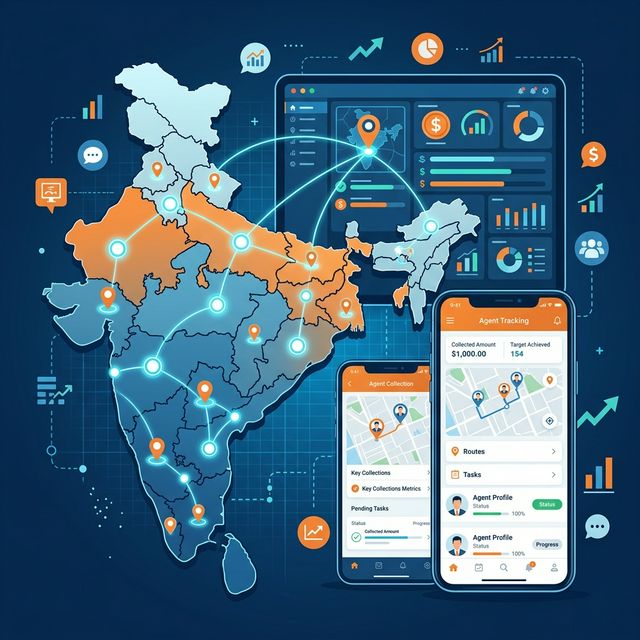
Ask any NBFC operations head where loan files get stuck and the answer is usually the same: CPV is pending. Bureau pulls return in seconds, bank statements are parsed in minutes, and e-KYC is instant. Contact point verification is the one step in the underwriting chain that still depends on a person travelling to an address, and its turnaround time (TAT) varies enormously by city, pincode and vendor.
This guide sets out what realistic CPV TAT looks like in India by city tier, explains the drivers behind those numbers, and gives a practical playbook for getting most of your cases verified on the same day. If you are new to the concept, start with our explainer on what CPV is and how it works, or the CPV glossary entry.
CPV TAT in India: The Short Version
- Metros — Typically same day to 48 hours from allocation for residence and office CPV
- Tier-2 cities — Commonly 1 to 3 working days, longer at month-end peaks
- Tier-3 and rural — Often 3 to 7 working days, sometimes more on cluster-visit schedules
- Biggest hidden delay — Time between the case being logged and the case reaching a field executive
- Biggest controllable driver — Address quality at the point of application
- Fastest lever — Auto-allocation by geo-location plus app-based report submission
Ranges reflect general industry practice in Indian retail and MSME lending, not a guarantee for any specific vendor, product or location.
What Exactly Is CPV TAT? Define the Clock First
Much of the confusion around CPV turnaround time comes from teams measuring different things. A vendor may quote "24-hour TAT" measured from the moment its supervisor accepts a case, while the credit team experiences three days because the case sat in an email inbox before acceptance and the report was scanned and mailed back a day after the visit. Before benchmarking, agree on one definition of the clock.
A useful breakdown splits end-to-end CPV TAT into five segments:
- Trigger to allocation: From the moment the loan origination system marks a case CPV-ready to the moment it is assigned to a named field executive
- Allocation to first attempt: Travel and scheduling time until the executive reaches the address for the first time
- First attempt to completed visit: Revisits caused by locked premises, the applicant being unavailable, or an untraceable address
- Visit to report submission: Time to write up observations, upload photographs and submit the report
- Report to decision: Quality check by the vendor or lender and the final positive, negative or refer outcome reaching the credit file
In paper-based agency setups, the first and fourth segments commonly account for a large share of total elapsed time, yet they involve no field work at all. That is why the fastest gains usually come from digitising handoffs rather than from pushing executives to drive faster.
CPV TAT Benchmarks by City Tier
The table below summarises typical ranges observed across Indian lenders for physical residence and office or business CPV, measured from allocation to submitted report. These are indicative industry ranges; your actual numbers will depend on product mix, vendor network, season and how well addresses are captured.
| City tier | Typical residence CPV TAT | Typical office / business CPV TAT | Main constraints |
|---|---|---|---|
| Metros (Mumbai, Delhi NCR, Bengaluru, Chennai, Hyderabad, Kolkata, Pune, Ahmedabad) | Same day to 48 hours | Same day to 48 hours; corporate HR confirmation can add a day | Traffic, gated societies and security desks, applicants away during working hours |
| Tier-2 cities (for example Jaipur, Lucknow, Indore, Coimbatore, Nagpur, Surat) | 1 to 3 working days | 1 to 3 working days | Thinner executive density, informal addresses in extended city limits, month-end volume spikes |
| Tier-3 towns and semi-urban pincodes | 2 to 5 working days | 2 to 5 working days | Few empanelled executives, longer travel, landmark-based addresses |
| Rural and remote pincodes | 3 to 7 working days or more | 3 to 7 working days or more | Cluster-visit scheduling, weather and harvest seasons, connectivity for report upload |
Two patterns sit behind these ranges. First, variance matters more than the average. A metro book may average under a day but still have a long tail of cases that take four or five days because of revisits. Track the 90th percentile, not just the mean. Second, tier labels hide pincode-level variation. A peripheral pincode in a metro district can behave like a tier-3 town, while a dense commercial pincode in a tier-2 city can achieve same-day closure. Benchmark at pincode or cluster level wherever volumes allow.
For how these ranges compare between agency and platform models, see our CPV agency vs digital CPV comparison.
The Five Drivers of Field Verification TAT
1. Allocation speed and logic
In many setups, cases are emailed or uploaded to a vendor portal in batches, then manually distributed by a supervisor. A case logged at 4 pm may not be assigned until the next morning. Rule-based auto-allocation, which assigns cases by pincode, executive location, current workload and product skill the moment they are triggered, removes this idle time entirely.
2. Travel distance and executive density
TAT rises sharply once an executive must travel more than a short distance to reach an address. In tier-3 and rural areas, vendors often wait to accumulate several cases in one direction before scheduling a trip. Lenders can shorten this by maintaining a wider executive network, using local branch or collection staff for verification where policy allows, and routing visits as optimised daily beats.
3. Address quality at application
Incomplete addresses, missing flat or shop numbers, landmark-only descriptions and mismatches between the application and KYC address are the single largest cause of revisits and "untraceable" outcomes. Capturing a geo-pin, a validated pincode and a mandatory landmark at the point of sourcing pays back many times over in TAT.
4. Applicant availability and appointment setting
Unannounced visits preserve the element of surprise but often find premises locked, particularly for salaried applicants in metros. Many lenders use a short appointment window or a pre-visit call for residence CPV in low-risk segments, while retaining surprise visits for higher-risk profiles and business premises.
5. Reporting format and quality check
Handwritten reports that must be scanned, couriered or retyped add a day or more. App-based capture with structured fields, geo-tagged and time-stamped photographs, and instant upload lets the quality check happen within minutes of the visit, and lets underwriters see the outcome without chasing the vendor.
How Digital CPV Changes the TAT Curve
Digital CPV does not make roads shorter, but it collapses the non-travel segments of the clock and gives lenders visibility into where each case stands. In practice, the improvements show up in four places:
- Instant trigger and allocation: The loan origination system pushes the case through an API, and the platform assigns it to the nearest available executive immediately
- Live tracking: Supervisors and credit teams see case status, executive location and expected completion time rather than calling the vendor for updates
- Structured, evidence-backed reports: Geo-fenced check-ins, face match against KYC photographs and mandatory photo fields reduce both turnaround and the need for re-verification
- Video and assisted verification for eligible cases: Where the lender's risk policy permits, low-risk residence checks can be completed through a recorded, geo-tagged video interaction, removing travel altogether
The result most lenders target is not a uniform improvement, but a reshaped distribution: a large majority of metro and tier-2 cases closing the same day, and a much shorter tail in tier-3 and rural pincodes. Our CPV verification page describes how CarmaOne combines field networks and digital capture to do this.
A Playbook for Same-Day CPV
Same-day verification is achievable for a meaningful share of cases in metros and larger tier-2 cities. The following steps, applied together, are what typically make the difference.
Trigger CPV early
Initiate CPV in parallel with bureau and bank statement analysis, not after them. Use a soft-approval rule so cases that will clearly be declined on bureau do not consume field capacity.
Set a cut-off time
Commit to same-day completion for cases triggered before a fixed time, such as early afternoon, and next-morning completion for later cases. A clear cut-off makes the SLA measurable.
Fix the address upstream
Make geo-pin, landmark and pincode validation mandatory in the sourcing app. Flag mismatches between application and KYC address before the case is allocated.
Auto-allocate by geography
Assign cases to the nearest qualified executive with spare capacity, and re-allocate automatically if a case is not started within a set window.
Tier your verification method
Reserve full physical CPV for higher-risk profiles and ticket sizes; use tele-verification or video CPV for low-risk salaried cases where policy allows. See CPV vs FI vs tele-verification.
Measure percentiles, not averages
Report median and 90th-percentile TAT by pincode cluster, vendor and product every week, and review the slowest decile case by case.
Planning for Tier-3 and Rural Pincodes
Same-day CPV across every rural pincode is rarely realistic, and chasing it can push vendors towards desk-based "drive-by" reports that defeat the purpose of verification. A better objective is predictable TAT with genuine proof of visit. Approaches that work in practice include:
- Published cluster schedules: Agree fixed visit days per rural cluster so sales teams can set borrower expectations honestly
- Local executive pools: Onboard verifiers who live in or near the cluster, trained and monitored through the same app as metro staff
- Offline-capable capture: Allow reports and photographs to be captured offline and synced once connectivity returns, with the original timestamp and location preserved
- Combined visits: Where policy and borrower consent permit, combine residence and business verification in one trip for self-employed applicants operating from home
- Season-aware capacity: Expect slower turnaround around harvest periods, monsoon months and festival seasons, and pre-book additional capacity
Writing a CPV SLA That Actually Holds
Turnaround commitments in many vendor contracts are vague, measured by the vendor and rarely enforced. Because CPV is typically an outsourced activity, the RBI's outsourcing expectations for regulated entities also call for defined service levels and ongoing performance monitoring. A practical SLA should specify:
- The exact start and stop events of the TAT clock, recorded by the system rather than reported by the vendor
- Separate TAT targets by city tier or pincode cluster, and by residence versus office or business verification
- Percentile-based targets (for example, a share of cases within a target window) rather than a single average
- Rules for revisits, untraceable addresses and refer cases, including how they are counted
- Minimum evidence standards per report: geo-tagged photos, time stamps, neighbour confirmation fields
- Quality metrics alongside speed, such as rework rate and audit-sample discrepancy rate, so speed is not bought at the cost of accuracy
Where CPV TAT Fits in Overall Underwriting TAT
CPV is usually the critical path in unsecured retail and MSME loans because everything else in the credit underwriting process can now run in minutes. Bureau, bank statement analysis and GST reconciliation can be completed while the field executive is on the way, so that by the time the CPV report lands, the credit appraisal memo is ready for the approver.
For lenders operating in co-lending partnerships, CPV evidence also has to be shareable with the partner bank in a format it can rely on. We cover those expectations in our guide to co-lending underwriting responsibilities. On CARMA Assess, CPV runs as one step in an orchestrated credit underwriting workflow, so a completed visit immediately updates the decision rather than waiting in a queue.
Cut CPV TAT Without Cutting Corners
Auto-allocated, geo-tagged, app-based CPV across metros, tier-2 towns and rural pincodes, integrated into your underwriting flow.