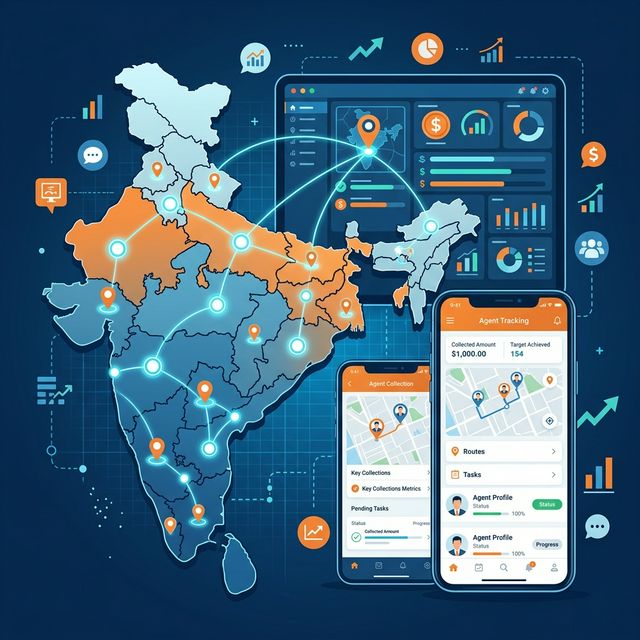
Every lender in India that disburses a loan on the strength of a physical address, a shop or a workplace has a Contact Point Verification (CPV) problem to solve. For two decades the default answer has been to empanel a handful of local agencies in each city, pay them per case, and hope the report that comes back is accurate. In 2026, that answer is being challenged by digital CPV platforms that combine a field-verification app, an allocation engine and a managed field network under one audit trail.
This guide is written for credit heads, operations heads and vendor-management teams at NBFCs, banks, housing finance companies and fintech lenders who are searching for a "CPV agency near me", evaluating a "CPV vendor for banks", or wondering whether CPV software can replace the agencies they already use. We compare the two models honestly: cost per case, turnaround time (TAT), city coverage, fraud-catch rate, auditability, scalability and compliance with the RBI's outsourcing expectations. We also cover when a traditional agency is still the right call, and how a hybrid model works in practice.
If you need a refresher on the basics first, read What is CPV in loans and CPV vs Field Investigation vs Tele-Verification. This article assumes you already run CPV and want to run it better.
CPV in India: What Lenders Typically See Today
- Rs 150 to Rs 600 — Typical per-case fee band for residence or office CPV through a local agency, varying by city tier and distance
- 24 to 72 hours — Industry-practice TAT for metro cases; 3 to 7 days is common in tier-3 towns and rural pin codes
- 5 to 15 agencies — Number of vendors a mid-sized NBFC typically empanels to cover its lending footprint
- Photo + signature — What most agency reports still rely on as proof of visit, with no geo-tag or timestamp validation
- Low single digits — Share of cases typically re-verified by lenders to audit agency quality
- Minutes, not days — Time a digital platform needs to allocate a case to the nearest available verifier
Indicative industry ranges; your numbers will vary by product, geography and vendor contract.
How Lenders Buy CPV Today: The Empanelled-Agency Model
The traditional CPV supply chain is simple on paper. The lender's operations or risk team empanels a set of local verification agencies, usually proprietorships or small partnerships, in each city it lends in. Cases are emailed or uploaded to a shared tracker, the agency sends a field executive to the address, and a report comes back as a PDF or a filled form with a photograph, a signature and a tick-box outcome: positive, negative, or "door locked / refer to credit".
Pricing is almost always per case, with surcharges for distance, repeat visits and out-of-city addresses, invoiced monthly and reconciled by ops. The model has survived because it is cheap to start and needs no technology. But it carries four structural weaknesses that become expensive as volumes grow.
1. Coverage gaps outside the agency's home city
A Lucknow agency covers Lucknow well, Barabanki poorly, and Gonda not at all. As NBFCs push into tier-3 and tier-4 markets, lenders end up with a patchwork of vendors, each with its own format, pricing and quality, and sub-contracting that is invisible to the lender.
2. Report quality cannot be verified
A photograph without a geo-tag and a timestamp proves nothing. Lenders routinely discover "desk verifications" only after a loan goes bad and the address turns out to be a vacant plot. Re-verification audits catch some of this, but only on the sample audited.
3. TAT is unpredictable and unenforceable
Without a system of record, SLAs live in a contract annexure and are enforced by phone calls. A case that sits for five days in a tier-2 town stalls the sanction, and the lender finds out only when sales escalates.
4. No dedupe, no fraud-ring detection
If the same mobile number, the same shop photograph or the same "neighbour" reference appears across 40 applications routed through three different agencies, no one sees it. Organised application fraud exploits exactly this blind spot.
What a Digital CPV Platform Adds
A digital CPV platform does not necessarily replace the human who walks to the door. It replaces the paperwork, the allocation phone calls and the trust-me reporting around that human. The core components are:
- Allocation engine: Cases flow in from the LOS via API and are auto-assigned to the nearest available verifier by pin code, load and quality score, with re-allocation if a visit is not completed within the SLA window
- Field verification app: Forces the verifier to capture geo-tagged, time-stamped photographs at the address, blocks gallery uploads and detects mock-location apps
- Liveness and face match: The applicant's doorstep selfie is matched against the KYC photograph, with liveness checks to stop photo-of-a-photo fraud
- OCR and document capture: Shop boards, utility bills, rent agreements and nameplates are photographed and OCR-extracted so the application address is compared to what was actually seen
- Structured questionnaire and auto-report: Product-specific checklists generate a standardised report in minutes, pushed straight back into the loan file
- Dedupe and fraud-ring detection: Phone numbers, device IDs, GPS coordinates, photographs and reference contacts are cross-matched across every case, flagging clusters no single verifier could notice
- Audit trail and SLA dashboard: Every allocation, visit attempt, photo and edit is logged; TAT is measured by the system, not reported by the vendor
The important shift is that the evidence standard moves from "the agency says the visit happened" to "the system proves the visit happened at this location, at this time, by this person". That is what changes the fraud-catch rate.
Side-by-Side: CPV Agency vs Digital CPV Platform
| Dimension | Empanelled CPV Agency | Digital CPV Platform |
|---|---|---|
| Cost per case (indicative) | Rs 150 to Rs 600 per visit; surcharges for distance and repeat visits; hidden cost of ops staff reconciling reports | Comparable or lower per visit at volume (field cost is similar; overhead drops); or a platform subscription plus per-case field fee |
| TAT | 24 to 72 hours in metros; 3 to 7 days in tier-3 and rural; not measured by system | Typically same-day to 48 hours with auto-allocation and re-allocation; measured and enforced by system |
| Coverage | City-by-city; gaps in small towns; sub-contracting invisible to lender | Pin-code level network managed centrally; verifier onboarding is standardised; coverage visible on a map |
| Proof of visit | Photo and signature, usually without geo-tag or timestamp validation | Geo-fenced, time-stamped photos; mock-location detection; liveness and face match |
| Fraud detection | Depends on the individual verifier; no cross-case matching | Dedupe across phone, device, GPS, photos and references; fraud-ring alerts; verifier quality scoring |
| Auditability | PDF reports and email trails; sample re-verification | Immutable case log; every photo and edit traceable; audit-ready exports for internal audit and RBI inspection |
| Scalability | Adding a city means finding and empanelling a new vendor; months of lead time | New geography is a network-expansion task on the same platform; weeks, not months |
| RBI outsourcing compliance | Possible, but documentation, vendor due diligence and performance monitoring are manual across many vendors | Single outsourcing arrangement with system-generated SLA reports, access controls and data-handling evidence |
Notice that the per-visit field cost does not collapse when you go digital; a person still has to travel to the address. The savings come from fewer repeat visits, lower ops headcount because reports are auto-generated and auto-reconciled, and lower credit losses because fabricated addresses are caught before disbursal rather than after.
Fraud-Catch Rate: Why the Evidence Standard Matters More Than Price
Lenders tend to negotiate CPV on price, but the metric that actually moves the P&L is the share of fraudulent or misrepresented applications stopped before money goes out. Three categories of fraud are specifically addressed by digital CPV and rarely caught by paper-based agencies:
- Address fabrication: The applicant does not live or operate at the address given. Geo-fencing, nameplate OCR and neighbour confirmation captured in-app make this hard to pass
- Impersonation: Someone else presents themselves as the applicant. Doorstep liveness and face match against the KYC photo closes this gap
- Organised rings: The same shop, the same reference mobile number or the same device appears across dozens of applications, often submitted through different DSAs and verified by different agencies. Only cross-case dedupe on a central platform surfaces this pattern
A useful internal exercise: pull your early-delinquency cases from the last 12 months and check how many carried a "positive" CPV report. The share that would have failed a geo-tagged, face-matched verification is the number to put against the cost of a platform.
When a Traditional CPV Agency Is Still the Right Choice
Digital is not automatically better. There are situations where the local agency remains the sensible option:
- Very low volumes: If you run under a few hundred CPVs a month in two or three cities, the overhead of a platform may not pay back and a well-managed agency relationship is fine
- Deep local knowledge for high-ticket cases: For secured, high-value loans where the verifier's judgement about the locality, the business and the family matters more than the checklist, an experienced local investigator is valuable. This is closer to field investigation than to CPV
- Connectivity-poor geographies: Some rural pockets still have patchy mobile data. A good platform handles offline capture and later sync; if your vendor's app does not, the agency model may be more reliable there
- Relationship-based rural lending: Microfinance and JLG models rely on a branch officer who knows the village. Digitising that officer's visit is useful; replacing it with a gig verifier is not
The honest framing is this: an agency is a labour supplier; a platform is a control system. You may need both.
The Hybrid Model: Platform Plus Managed Field Network
Most lenders that move to digital CPV in 2026 do not fire their agencies on day one. They adopt a hybrid structure:
- The platform is the single system of record. Every case, regardless of who performs the visit, is allocated, captured and reported through the platform's app
- Existing agencies are onboarded as verifier pools on the platform. Their executives use the app, so the evidence standard is identical across vendors
- A managed field network fills the gaps in cities and pin codes where no agency exists or where an agency consistently misses SLAs
- Vendor scorecards are computed from system data: TAT, re-visit rate, quality audit outcomes, fraud flags. Allocation shifts toward the best-performing pool automatically
This gets the lender a uniform audit trail and fraud controls immediately while preserving the agencies that are genuinely good. Over 12 to 18 months the mix typically shifts toward whichever pool delivers better quality at the same cost.
Pricing Models for Digital CPV
Whichever model you choose, insist that the commercial terms are tied to system-measured SLAs, not vendor-reported ones, and that your data (photos, GPS, reports) is exportable and remains yours at contract end.
RBI Context: Outsourcing, Digital Lending and Data Handling
CPV is an outsourced activity in most lenders, and the RBI's expectations on outsourcing apply. For NBFCs, the relevant guidance sits within the RBI Master Directions, including the Scale Based Regulation framework for NBFCs (2023) and the Master Direction on Outsourcing of Information Technology Services (2023). The RBI (Digital Lending) Directions, 2025 add expectations on data collection, consent and the conduct of third parties that touch borrower data. Banks are covered by their own outsourcing guidelines published under the same Master Directions and RBI notifications.
In practical terms, your CPV arrangement should evidence vendor due diligence at empanelment, a written agreement with service levels, periodic performance review, data confidentiality and access controls, business continuity, and the lender's right to audit. A platform generates this evidence as a by-product of operations; with a dozen paper-based agencies, it is a quarterly scramble.
Evaluation Checklist: Questions to Put in Your CPV RFP
Field capture and fraud controls
- • Does the app block gallery uploads and detect mock-location or rooted devices?
- • Are photos geo-fenced to the application address with a configurable radius?
- • Is doorstep liveness and face match against the KYC image supported?
- • What cross-case dedupe is run (phone, device, GPS, photo similarity, references)? Does the app work offline?
Allocation, TAT and coverage
- • How is a case allocated, and what happens if the verifier does not act within X hours?
- • Show pin-code level coverage for our top 50 lending locations, with active verifier counts
- • What is the measured median and 90th-percentile TAT for lenders of our profile?
- • Can we onboard our existing agencies as verifier pools on the platform?
Integration, audit and commercials
- • Is there an API to trigger CPV from our LOS and write the outcome back to the credit file?
- • Can internal audit and RBI inspection teams export the full case log for any period?
- • Where is data stored, who can access it, and what happens at contract exit?
- • Are commercials tied to system-measured SLAs, and how are "door locked" cases and re-visits billed?
Implementation: Moving from Agencies to a Digital CPV Platform
Baseline and pilot
Measure current cost per case, TAT and re-verification failure rate. Run a 4 to 6 week pilot on one product in two or three cities, with existing agencies onboarded to the app.
Weeks 1 to 6Integrate and standardise
Connect the platform to your LOS so CPV is triggered automatically at the right stage. Standardise questionnaires by product. Set SLA windows and re-allocation rules. Define how outcomes feed the underwriting decision.
Weeks 6 to 10Scale and optimise
Roll out across geographies, fill gaps with the managed network, and let vendor scorecards drive allocation. Review fraud-ring alerts weekly with the risk team and feed learnings into credit policy.
Months 3 to 6How CarmaOne Runs CPV: Platform Plus a Managed Field Network
CARMA Assess is CarmaOne's credit and vendor diligence product, and digital CPV is one of its core workflows. Lenders trigger residence, office, business and employer verification from their LOS, cases are auto-allocated to CarmaOne's managed field network across India or to the lender's own empanelled agencies working on the same app, and geo-tagged, face-matched, OCR-enriched reports flow back into the credit file. Cross-case dedupe and fraud-ring detection run across every verification, and the full audit trail is available for internal audit and regulatory review.
Because CPV sits inside the same platform as bureau, GST and bank statement analysis, the verification outcome is one input to an automated underwriting decision rather than a PDF someone has to read. For lenders using CARMA Core as their LOS the integration is native; for other loan origination systems, it is an API. To see where CPV sits in the wider sanction flow, read our guide to the credit underwriting process for NBFCs, the companion piece on bank statement analysis for MSME underwriting, and modern credit underwriting with GST and bureau data. Definitions are in the CPV glossary entry.
Replace Trust-Me Reports with Proof-of-Visit
Geo-tagged, face-matched, audit-ready CPV across India, with your agencies or ours, integrated into your underwriting flow.