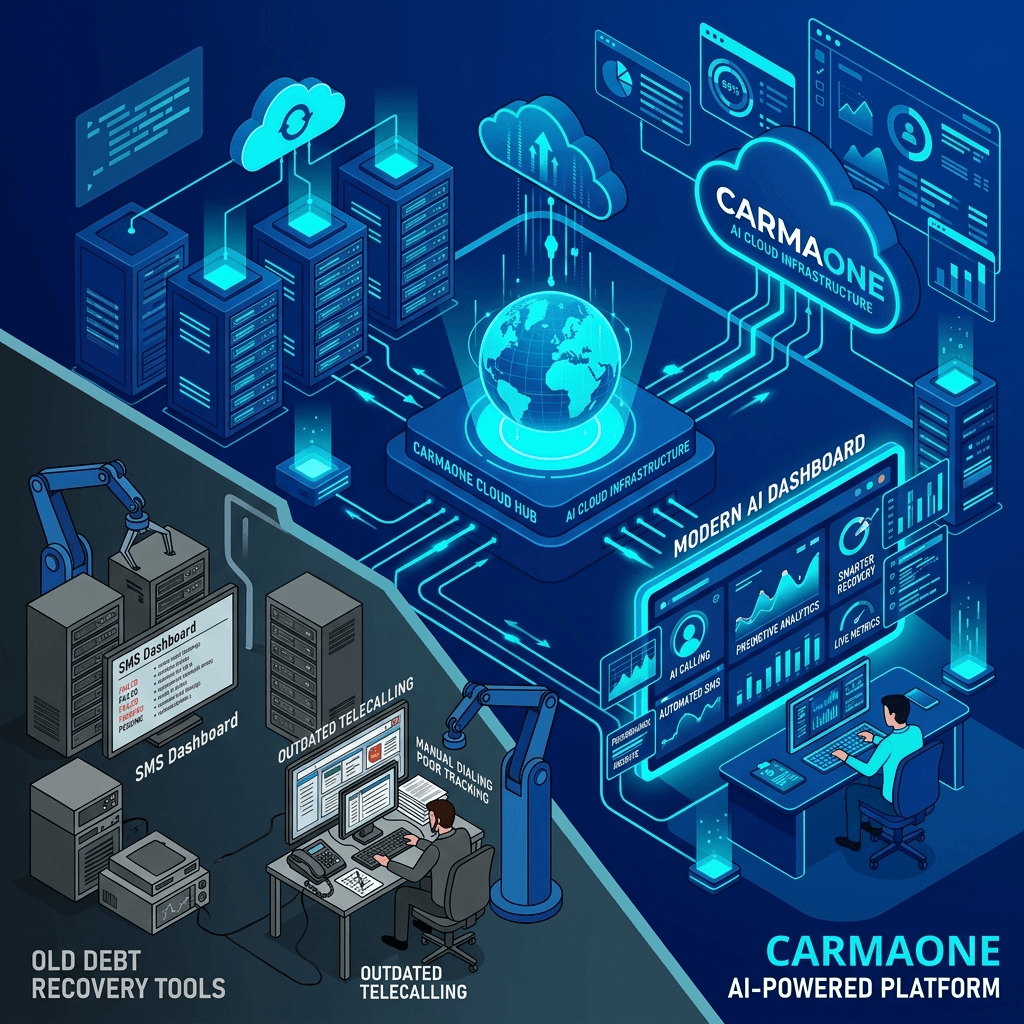
Search for a FinBox alternative and you will usually be comparing two different jobs. One is running credit policy at speed inside a digital lending journey: rules, scorecards, experiments and instant decisions. The other is underwriting a business borrower properly: reconciling GST, bank and bureau data, checking promoters and litigation, recording field verification and writing a memo a committee will sign. FinBox and CarmaOne overlap in the middle, but they start from opposite ends. This guide explains where each fits.
Last reviewed November 2026; check vendor sites for current offerings. Statements about FinBox below are summarised from its own public website, product documentation and press coverage, and are described as such. We have not included any FinBox pricing, customer counts or performance figures, because we could not independently verify them. FinBox, Sentinel and BankConnect are trademarks of their respective owners and are named here only for identification and comparison. CarmaOne publishes this article, so read it as one vendor's view and verify the details with each company.
The Short Answer
FinBox describes itself on its website as "the operating system for digital lending". Its flagship for credit teams is Sentinel, a credit decisioning platform where risk teams build and test policies without code, supported by BankConnect for bank data, DeviceConnect for device analytics, Account Aggregator connectivity and origination products. It is strongest where decisions need to be fast, configurable and embedded in a digital journey.
CarmaOne is built for MSME and business lending. CARMA Assess triangulates 13 core data engines, including GST, MCA, credit bureau, statutory and litigation records and bank statements, into one verdict in under 5 minutes. A configurable Business Rule Engine applies your policy, CPV and field investigation outcomes sit in the same file, Auto-CAM writes the credit memo in under 10 minutes, and Early Warning Signals keep re-grading borrowers after disbursal.
Put simply: FinBox is a decision engine and lending infrastructure you configure; CarmaOne is an underwriting and monitoring platform for business borrowers. Which one you need depends on your products and your team.
What FinBox Offers, According to Its Website
Based on FinBox's public website and documentation as of this review, the products most relevant to credit teams are:
- Sentinel: described as an AI-powered credit decisioning platform and "more than a rules engine; it's a full lending system". Its product page says risk teams can build workflows "without writing a single line of code" in an "Excel-intuitive language", backtest workflows on past data, run shadow testing, deploy in champion/challenger mode and roll out in canary mode.
- Data inside Sentinel: the same page says rules can draw on bureau, bank, GST and alternative data, as well as proprietary data and scorecards connected via APIs, with real-time workflow monitoring and analytics.
- Underwriting toolkit: its underwriting solution page lists a business rule engine, scorecards, a KYC module, a fraud engine, a risk-based pricing engine and dynamic offers, drawing on bureau, bank, GST, Account Aggregator, device and alternative data.
- BankConnect: a bank statement analyser that, per its product page, detects income, expenses, obligations and merchant category spends. FinBox's product documentation says statements can be obtained through net banking credentials, the Account Aggregator framework or PDF upload.
- Lending infrastructure: DeviceConnect for device analytics, a multi Account Aggregator product, Superflows for multi-channel origination, an LOS, digital onboarding and KYC, and products built on digital public infrastructure such as ULI and ONDC.
Press coverage from IBS Intelligence reported the launch of Sentinel AI in 2025, and later coverage in Tribune India described MCP support that lets credit decisions run inside AI conversations.
On the pages we reviewed, FinBox did not describe automated credit appraisal memo generation, CPV or field verification workflows, or MCA and litigation checks on promoters. Sentinel's "360° Monitoring" refers to monitoring decision workflows; we did not find a description of borrower-level Early Warning Signals after disbursal. Ask the vendor directly if those matter to you.
What CarmaOne Offers
CarmaOne's credit underwriting platform is designed for files where a person, not just a score, has to understand the borrower:
- Triangulated data: 13 core engines, including GST with 2,200+ automated checks, MCA ownership and director linkages, bureau repayment history, statutory and litigation records, and bank statements, cross-verified into one risk rating with red flags and recommended exposure.
- Bank statement analysis: PDF parsing across 77+ Indian bank channels or Account Aggregator fetch, with inflows mapped against GST turnover and bureau exposure, and circular banking flagged.
- Policy and approvals: a configurable Business Rule Engine with eligibility and knock-out rules, scorecards, deviations routed under your DOP matrix and a complete audit trail.
- CPV and Auto-CAM: CPV and field investigation outcomes recorded in the same file, and a committee-ready memo in your template with ratios such as FOIR and DSCR and confidence-rated recommendations.
- Post-disbursal Early Warning Signals: borrowers re-graded monthly to quarterly, using signals such as irregular GST filings, rising bounce rates, bureau score drift and new unsecured borrowings.
By CarmaOne's own figures, lenders typically go from roughly three hours of analyst time per file to about 15 minutes, and Auto-CAM replaces what is normally a 2 to 3 day memo exercise. Modules are available as pay-per-use APIs alongside an existing LOS, LMS or core banking system, and the full CARMA Core deployment typically takes 4 to 6 weeks.
CarmaOne vs FinBox: Side-by-Side
| Dimension | CarmaOne | FinBox (per its website) |
|---|---|---|
| Core positioning | Triangulated underwriting and monitoring for MSME and business lending | "The operating system for digital lending" |
| Rules and decisioning | Business Rule Engine, scorecards, deviations under DOP matrix | Sentinel no-code policies with backtesting, shadow, champion/challenger and canary modes |
| Bank statement data | 77+ bank channels or AA, reconciled with GST and bureau | BankConnect via net banking, AA or PDF upload |
| Alternative data | GST, MCA, statutory and litigation engines plus 8 specialised engines | Device, GST and alternative data stated |
| MCA and litigation | Director linkages, struck-off entities, adverse proceedings | Not described on the pages reviewed |
| Credit memo and CPV | Auto-CAM in under 10 minutes; CPV outcomes in the same file | Not described on the pages reviewed |
| Post-disbursal monitoring | Borrower-level Early Warning Signals, monthly-to-quarterly | Workflow monitoring in Sentinel stated; borrower EWS not described |
| Digital journey infrastructure | APIs alongside your LOS, LMS and CBS; CARMA Core as an option | Superflows, LOS, onboarding, KYC, DeviceConnect, ULI and ONDC |
The Real Difference: Policy Velocity vs Borrower Depth
A decision engine like Sentinel is built for policy velocity. Risk teams can change rules quickly, test them on history, run challengers against live traffic and push decisions inside an app journey. For high-volume digital products, that control is valuable and hard to replicate.
Business lending tends to fail for different reasons. A distributor's GST turnover may not match its bank inflows. A promoter may be linked to struck-off entities. A borrower that looked fine at sanction may start missing GST filings six months later. Catching those signals needs sources reconciled against each other, a memo that explains them to a committee, and monitoring that keeps reading the borrower after disbursal. That is the job CarmaOne is designed around.
The two are not mutually exclusive. A lender can run instant decisions on small-ticket digital loans through a decision engine and route larger MSME files to a triangulated underwriting and Auto-CAM workflow.
When FinBox Is the Better Choice
FinBox may suit you better if:
- You run high-volume digital lending journeys where decisions must be instant and embedded in an app or partner channel.
- Your risk team wants to write and iterate on policies itself, with backtesting, shadow testing and champion/challenger experiments.
- You need device analytics and digital footprint signals as part of your risk models.
- You want origination, onboarding, KYC and decisioning infrastructure from one provider, including rails such as ULI and ONDC.
- Your products are small-ticket or consumer-led, where a full credit memo and field verification are not part of the process.
When CarmaOne Is the Better Choice
- You lend to MSMEs, proprietorships, partnerships, LLPs and corporates, where GST, MCA and litigation checks matter as much as bureau data.
- Your files go to a credit committee and need a structured, auditable memo with deviations and approvals recorded.
- You want CPV and field investigation outcomes in the same file rather than in a separate spreadsheet.
- You need borrower-level Early Warning Signals after disbursal, on the same platform that underwrote the loan.
- You do not have a large in-house team to build triangulation and scoring logic yourself.
A Practical Way to Evaluate
- Segment your products. Separate instant digital products from committee-approved business loans.
- Back-test real files. Run a sample of performing and defaulted MSME files and compare which red flags each platform surfaced.
- Measure time to sanction. Include memo preparation and approvals, not only decision latency.
- Check monitoring. Ask how each would have flagged defaulted borrowers months before default.
For a wider view, see our top 10 credit underwriting software in India and top 10 bank statement analyser software guides, or the comparison hub. For other analyser-led vendors, read CarmaOne vs Perfios and CarmaOne vs ScoreMe. If you assess suppliers or distributors rather than borrowers, see vendor due diligence.
The Verdict
If you need a flexible, no-code decision engine and digital lending infrastructure for high-volume journeys, FinBox is worth a serious look. If you underwrite MSME and business loans and want GST, bureau, bank statement, MCA and litigation data triangulated, with CPV, Auto-CAM and post-disbursal monitoring in one platform, CarmaOne is built for that job.
See CarmaOne Credit Underwriting →