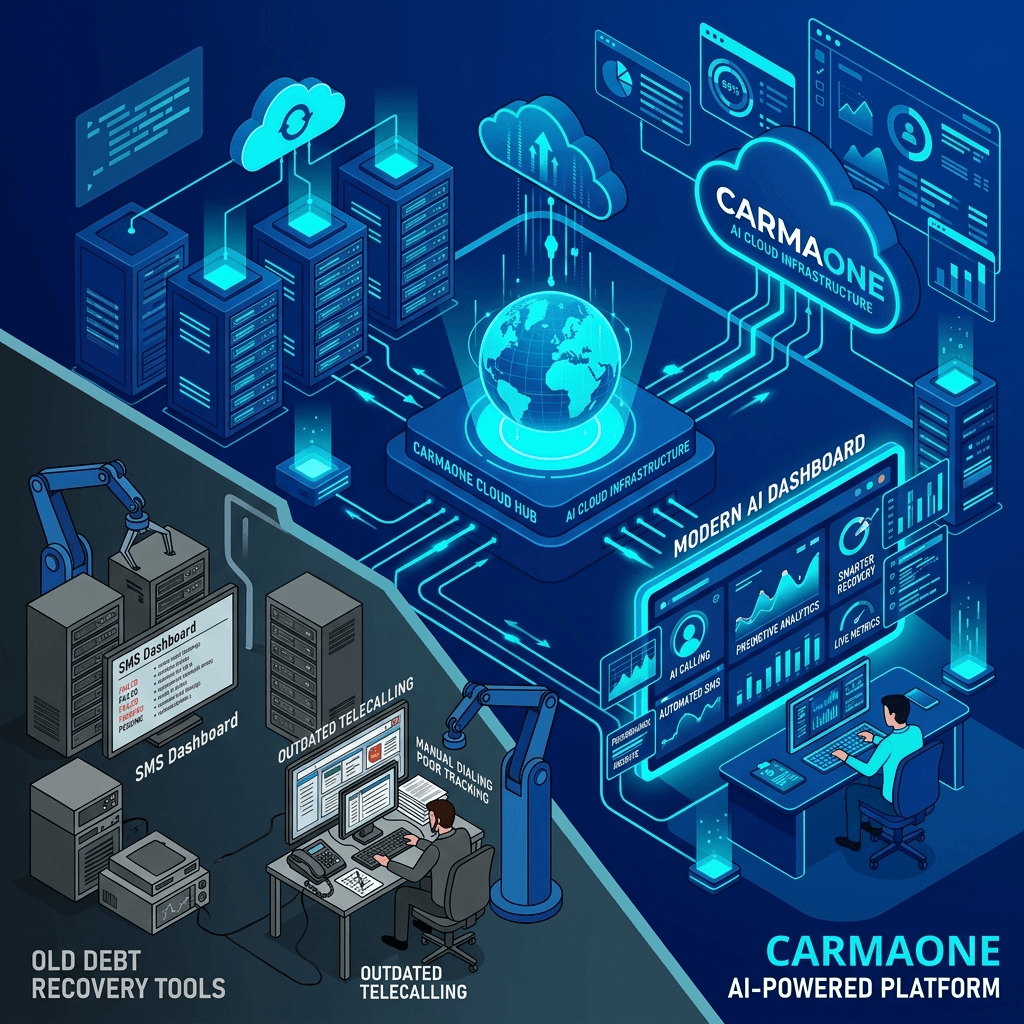
Collections leaders evaluating AI calling in India often shortlist SquadStack. It is a well-known name in voice AI for sales and customer engagement, and it also offers a loan EMI collections use case. CarmaOne approaches the same problem from the other end: it starts with recovery outcomes and uses AI calling as one of three pillars, alongside field and legal. This guide sets out what each offers so you can choose the right fit.
Last reviewed November 2026; check vendor sites for current offerings. Statements about SquadStack are summarised from its public website and described as such. We have deliberately left out competitor pricing, customer counts and performance claims, since we could not independently verify them. SquadStack is a trademark of its owner and is named here only for identification and comparison.
The Short Answer
SquadStack, according to its website, provides "Outcome-Driven Voice AI Agents for Sales in India", with use cases that include sales, workforce hiring, customer support and loan EMI collections. It is a voice AI and omnichannel outreach platform, with complex conversations warm-transferred to human agents.
CarmaOne, through CARMA Recover, is an outcome-based collection service. It uses an AI calling engine across 15+ Indian languages for first-touch outreach, then escalates to on-ground field teams and legal action where needed. It is paid a success fee on what is recovered, with no monthly minimums.
If your challenge is reaching and nudging borrowers at scale in early buckets, both are relevant. If your challenge is recovering money from accounts that have stopped responding, the field and legal layers become the deciding factor.
What SquadStack Offers, According to Its Website
From SquadStack's public website and its loan EMI collections page as of this review:
- Voice AI agent platform: its platform menu lists its own speech-to-text (Arth), a humanoid AI agent stack, an in-app voice assistant, AI call quality analysis, analytics and reporting, and lead management with omnichannel outreach.
- Channels: its site describes calls, WhatsApp, SMS and in-app channels with shared memory, and its collections page refers to engaging debtors across calls, WhatsApp, SMS and email.
- Collections buckets: the loan EMI collections page describes pre-due and due-date reminders, early-bucket (1 to 30 DPD) outreach to confirm intent and capture promises to pay, and mid-bucket (31 to 60 DPD) re-engagement and broken-PTP follow-ups. Its FAQ says scripts and escalation rules can be configured for late delinquency buckets.
- Human handover: the site says calls can be transferred to live collection agents for disputes, negotiations or complex cases.
- Languages: its FAQ names nine languages: Hindi, English, Tamil, Telugu, Kannada, Marathi, Malayalam, Gujarati and Bengali, with mid-sentence switching and mixed-language support.
- Compliance: the collections page refers to TRAI-aligned calling hours, script governance and audit-ready logs, and the site shows DPDP, TRAI, SOC 2 Type 2 and ISO 27001/27701 badges.
- Industries: lending and credit, banking, insurance, brokerage, education, e-commerce, healthcare, real estate, automotive and others.
On the collections pages we reviewed, SquadStack did not describe field visits or legal escalation services. Its escalation path is to human agents on calls.
What CarmaOne Offers
CARMA Recover is a single engagement covering three integrated pillars:
- AI-led digital engagement: AI calling agents across 15+ Indian languages with multi-channel orchestration, real-time dashboards, and dispute and settlement workflows.
- Pan-India field escalation: on-ground teams across 22+ states and 14,000+ pin codes, with vernacular engagement and location-tuned follow-ups.
- Legal enforcement and settlement: escalation through EOW, SARFAESI, Section 138, civil suits or arbitration for approved cases, backed by NBFC-ecosystem legal partnerships.
The commercial model is a success fee: a percentage of every rupee recovered, with no monthly minimums and no floor charges. CarmaOne first assesses your book by bucket aging, borrower profile and complexity, then prices a plan matched to what is realistically recoverable. By CarmaOne's own figures, 76% of its collections come from 90+ DPD accounts. Teams that prefer to run recovery in-house can use CarmaOne's debt collection software instead.
CarmaOne vs SquadStack: Side-by-Side
| Dimension | CarmaOne (CARMA Recover) | SquadStack (per its website) |
|---|---|---|
| What you buy | Managed recovery outcome across calling, field and legal | Voice AI agents and omnichannel outreach platform |
| Primary focus | Collections, especially 90+ DPD and B2B receivables | Sales-led positioning; collections is one use case |
| Bucket coverage described | Early, mid, hard, deep and write-off playbooks | Pre-due, 1 to 30 and 31 to 60 DPD; configurable for late buckets |
| Languages | 15+ Indian languages | Nine languages named, with code-mixing |
| Human escalation | Field teams for visits; legal team for enforcement | Warm transfer to live agents on calls |
| Field collections | 22+ states, 14,000+ pin codes | Not described on the collections pages reviewed |
| Legal escalation | EOW, SARFAESI, S.138, civil suits, arbitration | Not described on the collections pages reviewed |
| Commercial basis | Success fee on amounts recovered | Usage-based platform pricing per its site; confirm with vendor |
Outreach Is Not the Same as Recovery
A good voice AI agent can call an entire allocation quickly, remind borrowers in their language, capture promises to pay and send payment links. For early-bucket accounts that are willing but forgetful, that is often enough, and SquadStack's collections page is clearly built for that stretch of the lifecycle.
The economics change as accounts age. Contactability drops, disputes increase, and some borrowers or business debtors simply stop engaging. At that point, more calls rarely help. What moves the account is a field visit, a structured settlement, or a legal step such as a Section 138 notice. If your calling platform does not cover these, you will need separate field agencies and law firms, plus the effort of coordinating them.
CarmaOne's approach is to keep all of these under one roof, with one dashboard and one commercial model tied to recovery. That trade-off makes most sense for portfolios with a large hard-bucket share.
When SquadStack Is the Better Choice
SquadStack may be the stronger fit if:
- You want one voice AI vendor across sales, onboarding, support and collections, rather than a collections specialist.
- Your collections need is concentrated in pre-due, early and mid buckets, where calling and digital nudges do most of the work.
- You already have your own field force and legal panel and only need to automate the calling layer.
- You want features such as in-app voice assistants, call quality analysis and A/B testing of scripts and channels, which SquadStack describes on its site.
- You prefer a usage-based platform cost and want to keep recovery operations fully in-house.
When CarmaOne Is the Better Choice
- A large share of your portfolio is 90+ DPD, NPA or written off.
- You want field and legal escalation included, without managing extra vendors.
- You want to pay only when money is recovered, with no monthly minimums.
- You collect B2B receivables from distributors, dealers, contractors or MSMEs, where physical presence and legal options carry weight.
- You want every action, from the first AI call to settlement or litigation, visible in a single dashboard, with your approval before legal steps.
Questions to Ask Either Vendor Before You Sign
Whichever direction you lean, a short list of direct questions will surface the real fit faster than any feature sheet:
- What happens after the call? When a borrower or business debtor stops answering, what is the next step, who performs it, and how long does it take?
- Who carries the cost of failure? If an allocation does not convert, do you still pay for minutes, seats or setup, or is the fee tied only to money recovered?
- How are languages tested? Ask for sample calls in the specific languages and dialects your borrowers use, on real telephone audio, not studio demos.
- How are disputes handled? Check whether disputes and settlement requests are logged in a workflow you can see, rather than only in call notes.
- What evidence do you receive? For audits, you need recordings, transcripts, visit proof and a clear trail of every legal step taken on your behalf.
- How does data flow back? Confirm that dispositions, promises to pay and payments update your LMS or ERP without manual reconciliation.
A platform vendor will usually give strong answers on languages, integrations and analytics. An outcome-based partner should give equally clear answers on field coverage, legal escalation and how its fee is calculated. If either side is vague in its own area of strength, treat that as a signal.
How to Run a Fair Pilot
- Segment by DPD. Run early buckets on the calling platform of your choice and give a matched hard-bucket slice to an outcome-based partner.
- Count total cost. Include platform usage, telephony, internal staff, agency commissions and legal fees, not only the vendor invoice.
- Track roll-forward and resolution. Look at how many accounts were actually closed or settled, not only how many promises were captured.
- Audit conduct. Sample recordings and visit records against RBI fair practices expectations for every vendor.
For more context, see our guide to the best voice AI agents for Indian languages, the CarmaOne comparison hub, and our reviews of CarmaOne vs Credgenics and CarmaOne vs Spocto. If you are weighing other voice AI platforms, read CarmaOne vs Gnani.ai, and for another outcome-led collections provider, see CarmaOne vs DPDzero.
The Verdict
SquadStack is a strong option if you want voice AI outreach across sales, support and early-stage collections, run by your own team. CARMA Recover is built for lenders and businesses that want recovery itself handled end to end, from AI calling to field visits to legal action, paid only on results.
Explore CARMA Recover →