If you have searched for "gnani.ai vs skit.ai for collections", you are probably trying to pick a voice AI engine for your recovery team. That is a sensible question, but it is often the second question. The first is whether you want to buy a voice AI platform and run collections yourself, or hand over a portfolio to a partner that owns the outcome across calling, field and legal. This guide compares Gnani.ai and CarmaOne on that basis, honestly and without spin.
Last reviewed November 2026; check vendor sites for current offerings. Statements about Gnani.ai and Skit.ai below are summarised from their own public websites and are described as such. We have not included any competitor pricing, customer counts or performance figures, because we could not independently verify them. Gnani.ai and Skit.ai are trademarks of their respective owners and are named here only for identification and comparison.
The Short Answer
Gnani.ai is, according to its website, an enterprise voice AI company that builds its own speech-to-text, text-to-speech and language models and offers voice agents, analytics, agent assist and voice biometrics across industries, with collections listed as one of many use cases. It is a technology platform you deploy inside your own operation.
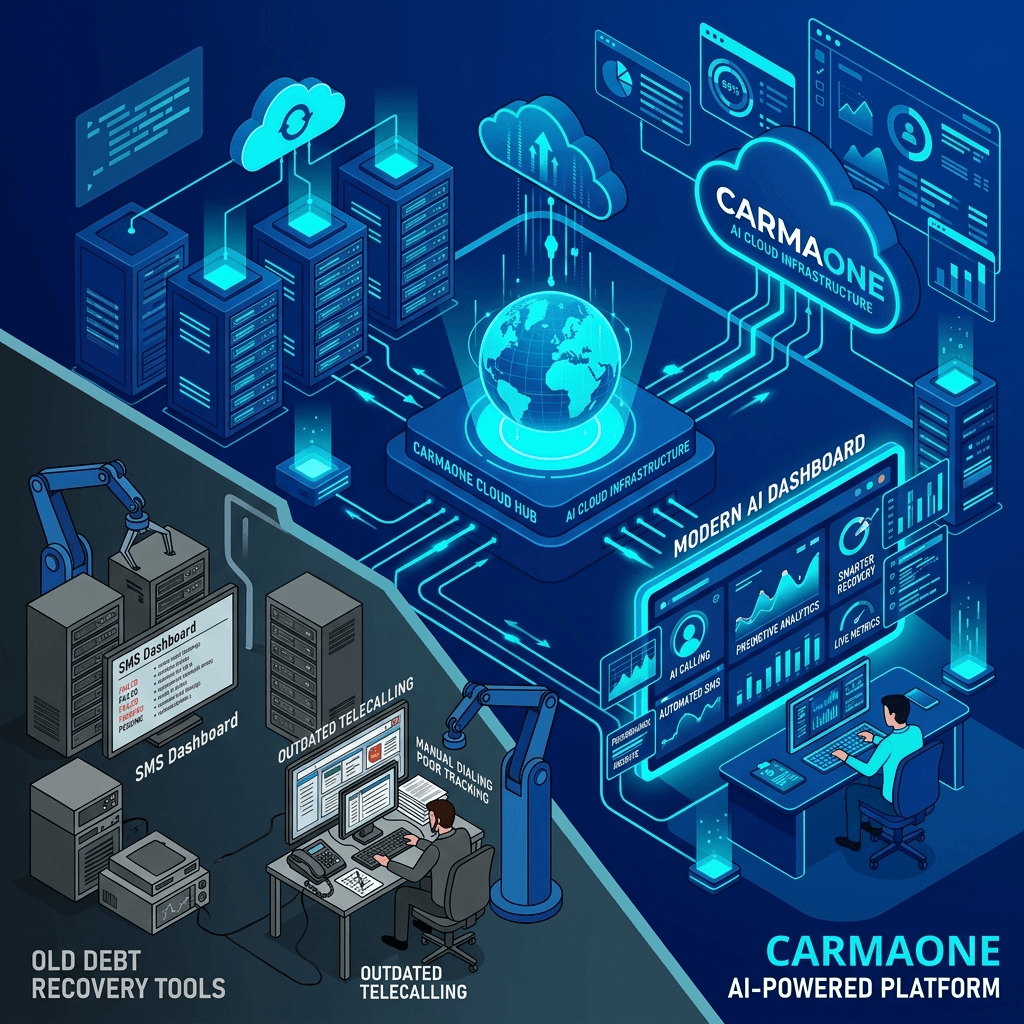
CarmaOne, through CARMA Recover, is an outcome-based receivables collection service. It combines an AI calling engine across 15+ Indian languages with on-ground field teams and legal escalation, and it is priced on a success fee: a percentage of what is recovered, with no monthly minimums and no floor charges.
So the comparison is less "which bot sounds better" and more "do you want a tool, or a recovery partner that uses tools?" Both are valid answers for different lenders and businesses.
What Gnani.ai Offers, According to Its Website
Based on Gnani.ai's public website as of this review, the company describes itself as "The Frontier AI Company for Enterprise". The points most relevant to collections teams are:
- Own model stack: its site lists in-house speech-to-text (Gnani Prisma), text-to-speech (Gnani Timbre), a language model (Gnani Evon) and a speech-to-speech model, tuned for telephone-quality audio.
- Broad language coverage: its FAQ states support for 40+ languages and dialects, naming Hindi, Tamil, Telugu, Kannada, Malayalam, Bengali, Gujarati, Marathi and Punjabi among others.
- Enterprise products: voice agents, analytics (including sentiment analysis and quality checks), agent assist and voice biometrics.
- Omnichannel agents: its enterprise page describes handling conversations across voice, WhatsApp, chat and SMS from one platform, with context-aware handoffs to human agents.
- Collections and recovery use case: its solutions page describes outbound reminder and negotiation calls, payment plan enrollment over voice, dispute escalation to human agents, and full call recording with an audit trail.
- Deployment flexibility: its website says it can deploy on cloud, private cloud, on-premise and air-gapped environments, and lists integrations with common CRM, CCaaS and telephony tools.
- Security claims: its FAQ states SOC 2 and ISO 27001 certification and compliance with several data protection standards.
On the pages we reviewed, Gnani.ai's site did not describe field collection agents or legal recovery services. That is not a criticism; it is simply not what a voice AI platform is built to do.
Where Skit.ai Fits in a "Gnani.ai vs Skit.ai" Search
Skit.ai is the other name that comes up in this query. According to its website, Skit.ai positions itself specifically as AI debt collection software, with AI agents that contact consumers across calls and messages, handle routine follow-ups and pass disputes or hardship cases to human specialists. Its site emphasises compliance with US collection rules and lists a New York headquarters, while also referencing an India presence.
In simple terms: Gnani.ai presents itself as a horizontal enterprise voice AI platform with collections as one use case, while Skit.ai presents itself as collections-focused voice AI. Both are technology you operate. If you are choosing between them, evaluate language accuracy on your own call recordings, integration with your LMS or CRM, and how each handles RBI conduct rules for Indian portfolios. If you want a wider view of voice engines, see our guide to the best voice AI agents for Indian languages in 2026.
What CarmaOne Offers
CARMA Recover is built on three integrated pillars, all priced on outcome:
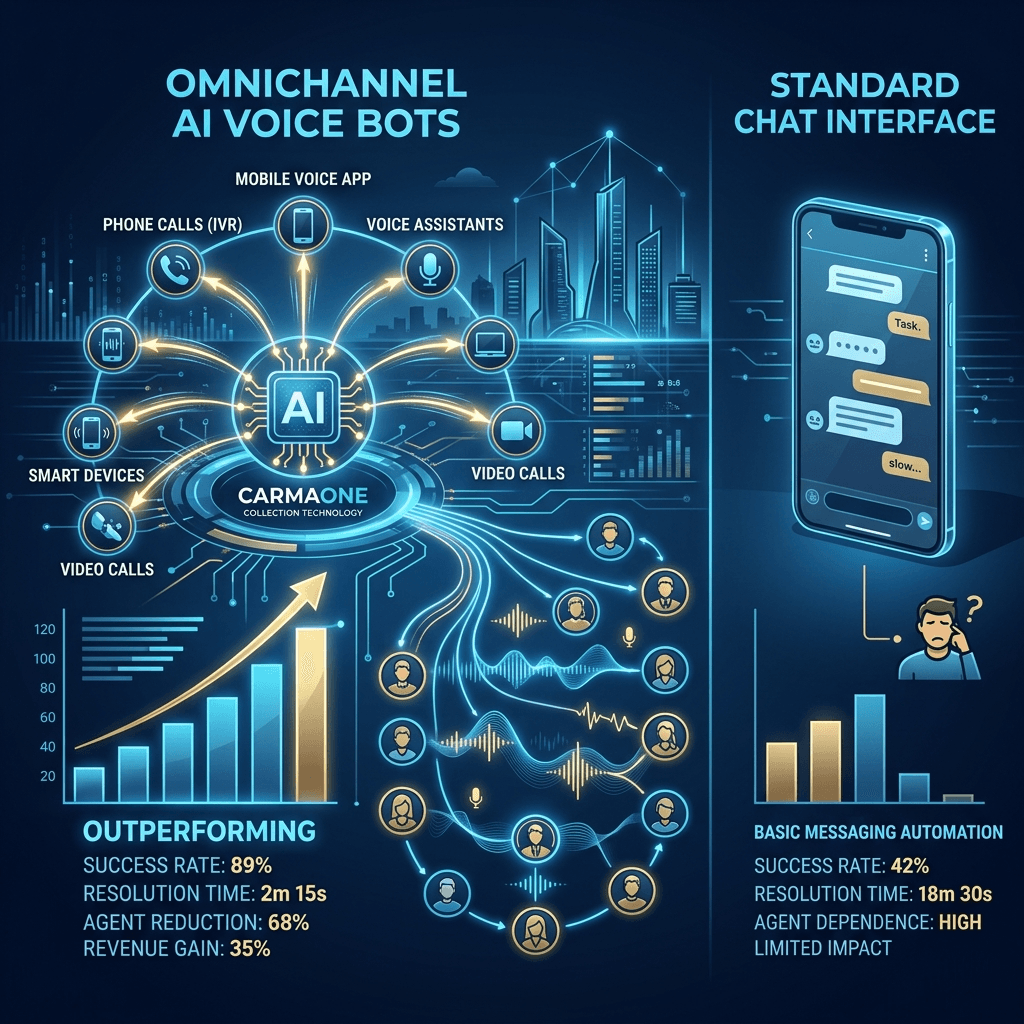
- AI-led digital engagement: AI calling agents across 15+ Indian languages plus multi-channel orchestration for first-touch outreach, backed by real-time dashboards and dispute and settlement workflows.
- Pan-India field escalation: on-ground teams across 22+ states and 14,000+ pin codes, with vernacular engagement and follow-ups tuned to location and borrower profile, for accounts that need a human visit.
- Legal enforcement and settlement: for approved cases, escalation through EOW, SARFAESI, Section 138, civil suits or arbitration, backed by NBFC-ecosystem legal partnerships, with your approval at every step.
CARMA Recover is designed for the hard bucket. By CarmaOne's own figures, 76% of its collections come from 90+ DPD accounts, with bucket-wise playbooks for early, mid, hard, deep and write-off stages. It is used for B2B receivables across manufacturing, distribution, infrastructure, logistics and anchor-backed MSME books, as well as lending portfolios. If you want to run collections in-house on software, CarmaOne also offers debt collection software.
CarmaOne vs Gnani.ai: Side-by-Side
| Dimension | CarmaOne (CARMA Recover) | Gnani.ai (per its website) |
|---|---|---|
| What you buy | Managed recovery outcome: software, calling, field and legal | Enterprise voice AI platform you deploy and operate |
| Primary focus | Collections and receivables recovery, especially 90+ DPD | Horizontal voice AI; collections is one of several use cases |
| Voice AI languages | 15+ Indian languages | 40+ languages and dialects stated |
| Own speech models | AI calling engine inside a collections workflow | In-house STT, TTS, LLM and speech-to-speech models stated |
| Field collections | On-ground teams, 22+ states, 14,000+ pin codes | Not described on the pages reviewed |
| Legal escalation | EOW, SARFAESI, S.138, civil suits, arbitration | Not described on the pages reviewed |
| Commercial model | Success fee on amounts recovered; no minimums | Not published on the pages reviewed; ask the vendor |
| Deployment | Managed service with dashboards for full visibility | Cloud, private cloud, on-premise or air-gapped stated |
The Real Difference: Who Owns the Last Mile?
Voice AI is excellent at the first stretch of collections: reminders, promise-to-pay capture, payment links and routine follow-ups at scale. A strong platform such as Gnani.ai can take a large share of that calling load off a human team.
The harder question is what happens to accounts that do not answer, dispute the amount, or simply refuse. For those, recovery usually needs a person at the door, a settlement conversation, or a legal notice. With a pure-technology platform, you supply that last mile yourself, through internal field staff, collection agencies and law firms. With CarmaOne, those steps sit inside the same engagement and the same dashboard, and CarmaOne is paid only when money is recovered.
Neither model is automatically better. It depends on how much of your book is early-stage versus hard-bucket, and how much operational capacity you already have.
When Gnani.ai Is the Better Choice
Be honest with your own requirements. Gnani.ai may suit you better if:
- You want to own and operate your voice AI in-house, with your own collections team and agency network already in place.
- You need voice AI across many functions, such as customer service, KYC and sales, not only collections.
- You have strict infrastructure needs, such as on-premise or air-gapped deployment, which Gnani.ai says it supports.
- You need wide language and dialect coverage beyond what a collections-specific engine offers.
- Your book is mostly early-bucket, where reminders and PTP capture do most of the work and field or legal action is rare.
- You prefer paying for technology and keeping all recovery upside and control internal.
When CarmaOne Is the Better Choice
- A meaningful part of your book is 90+ DPD, written off, or otherwise stuck after digital outreach has run its course.
- You do not want to manage separate vendors for calling, field visits and legal notices.
- You want cost tied to recovery, with no monthly minimums or floor charges.
- You are recovering B2B receivables from distributors, dealers or MSMEs, where on-ground presence and legal options such as Section 138 matter.
- You want one view of every account, from the first AI call through to settlement or litigation.
A Practical Way to Evaluate
Many lenders run both models side by side. A sensible pilot looks like this:
- Split by bucket. Keep early-bucket accounts on your in-house stack, whether that uses Gnani.ai, Skit.ai or another engine.
- Allocate a hard-bucket slice. Give a defined set of 90+ DPD or written-off accounts to an outcome-based partner.
- Measure net recovery. Compare amounts recovered minus all costs: licences, telephony, internal staff time, agency fees and legal costs.
- Check conduct. Review call recordings and visit evidence against RBI fair practices expectations, regardless of vendor.
For more on how different vendors compare, see our comparison hub, as well as CarmaOne vs Credgenics and CarmaOne vs Spocto. If you are also weighing voice AI combined with human telecalling, read CarmaOne vs SquadStack, and for another outcome-led collections model, see CarmaOne vs DPDzero.
The Verdict
If you need a powerful, flexible voice AI platform to run inside your own operation, Gnani.ai is worth a serious look. If you need someone to own recovery end to end, from AI calling through field visits to legal escalation, and to be paid only when you are, CARMA Recover is built for that job.
See How CARMA Recover Works →