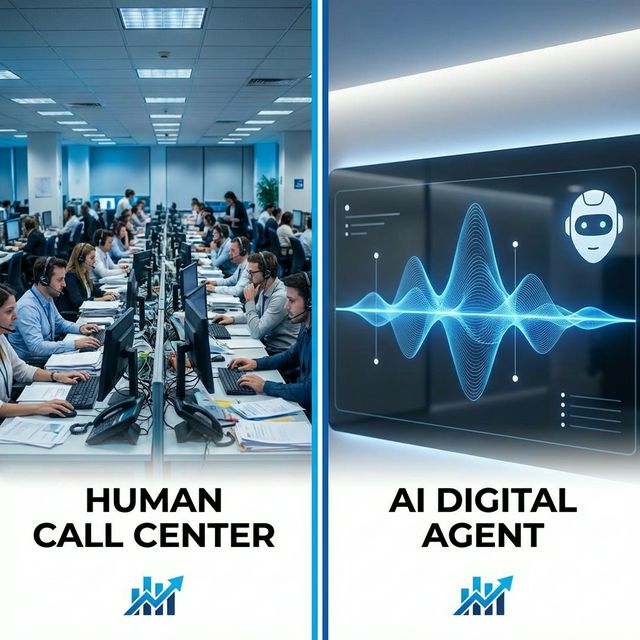
Most Indian lenders already use two of the three. There is an IVR or pre-recorded voice blast for reminders, and a telecalling team (in-house or outsourced) for everything else. The question in 2026 is where the third option, the conversational AI voice agent, fits, and whether it should replace either of the others.
This guide compares all three on what they can do, what they cost, how they hold up on compliance and how they scale, then lays out a practical model for splitting work between them. If your main question is cost, pair this with our detailed AI calling vs human telecallers cost comparison and the telecaller cost calculator.
Key Takeaway
IVR is cheap but one-way. Telecallers are flexible but expensive, hard to scale and inconsistent on compliance. AI voice agents sit in between: two-way conversations at near-IVR scale. For most lenders the answer is not one or the other but a tiered model: IVR or WhatsApp for simple nudges, AI voice agents for the bulk of conversational calls, and a smaller, better-trained human team for complex cases.
The Three Options at a Glance
IVR / voice blast
Pre-recorded message, optionally with keypad input ("press 1 to pay"). Ideal for one-way reminders at very high volume. Cannot understand speech or answer questions. See the IVR glossary entry.
Human telecaller
Trained agent, usually on a predictive or progressive dialer. Handles any conversation, including hardship, disputes and settlements. Limited by headcount, shift hours, attrition and training.
AI voice agent
Speech recognition, a language model and natural TTS in a live two-way call. Understands replies, captures promises to pay, answers common questions and escalates when needed. Scales to thousands of concurrent calls.
Side-by-Side Comparison
| Factor | IVR | Telecaller | AI voice agent |
|---|---|---|---|
| Conversation | One-way or keypad | Fully open | Two-way, goal-driven |
| Captures PTP with date | Rarely | Yes | Yes, structured and logged |
| Handles objections | No | Yes, varies by agent | Common ones, consistently |
| Complex negotiation | No | Best option | Limited; escalate |
| Scale and peaks | Very high | Bound by headcount | Very high |
| Languages | Pre-recorded per language | Depends on hiring | Many, with code-switching |
| Cost structure | Lowest per call | Highest, mostly fixed | Low, variable |
| Compliance consistency | High but blunt | Depends on supervision | High, every call recorded |
| Setup time | Days | Weeks to hire and train | Days to a few weeks |
| Borrower experience | Often ignored | Personal, varies | Natural if well built |
Understanding the Cost Structures
The three options do not just cost different amounts; they cost money in different ways, which matters for budgeting.
- IVR is almost entirely variable: telephony minutes plus a small platform fee. It is the cheapest per call, but many calls produce no usable outcome, so the cost per useful contact can be higher than it first appears.
- Telecallers are mostly fixed: salaries, incentives, seats, dialer licences, supervisors, quality analysts, training and the hidden cost of attrition. You pay for capacity whether or not volume shows up, and you cannot add capacity quickly when it does.
- AI voice agents are mostly variable, usually priced per minute, per call or per outcome. Capacity scales up for EMI-date peaks and down mid-month. Our AI calling pricing guide explains the models in detail.
The fair comparison is cost per right-party contact and cost per rupee recovered, not cost per call. Run your own numbers in the telecaller calculator.
The Borrower's Point of View
It is easy to forget that the borrower experiences all three channels. A recorded IVR blast feels impersonal and is often cut within seconds. A rushed telecaller chasing a daily target can come across as pushy, and on a bad day can cross the line into conduct that triggers complaints. A well-built AI agent is polite on every call, speaks the borrower's language, never raises its voice and offers a human when asked. Many borrowers also find it easier to admit a cash crunch to an automated assistant than to a person. The goal is not to trick borrowers into thinking they are talking to a human, but to make the conversation quick, clear and respectful.
A 90-Day Rollout Plan
Days 1 to 30: Pilot
Pick one segment, such as pre-due or 1 to 30 DPD, in one or two languages. Keep a holdout group on your existing process and compare contact, PTP and kept-promise rates.
Days 31 to 60: Expand and integrate
Add languages and buckets, connect escalations to your telecaller queue with full context, and switch low-risk nudges to WhatsApp or IVR.
Days 61 to 90: Re-plan the team
Redeploy telecallers to later buckets, settlements and hardship cases rather than cutting abruptly. Freeze new hiring for early-bucket calling and track cost per rupee recovered month on month.
Where IVR Still Makes Sense
IVR is not obsolete. For a pre-due reminder to a low-risk borrower who has never missed an EMI, a short recorded message (or a WhatsApp reminder) may be all that is needed. It is also useful for mass service announcements. Its weaknesses show up as soon as the borrower needs to say something: "I already paid", "my salary is late", "this is the wrong number". IVR cannot record those reasons, so the account goes back into the queue with no new information.
Predictive dialers that front human teams have their own problem: when the dialer connects more calls than agents are free, callers hear silence and the call drops. A high dialer drop rate wastes contacts and can feel like harassment to borrowers. AI agents remove that problem because every connected call is answered immediately.
Where Human Telecallers Still Win
- Hardship and restructuring: job loss, medical emergencies and family situations need judgement and empathy, and often a policy exception.
- Settlements and OTS: negotiating a one-time settlement within delegated authority.
- Disputes: payment not reflected, mis-sold products, fraud claims.
- High-value accounts: MSME and secured loans where a relationship matters.
- Escalations from AI: borrowers who ask for a human, or calls the AI flags as sensitive.
Where AI Voice Agents Fit Best
AI voice agents are strongest on high-volume, repetitive conversations that still need two-way dialogue:
- Pre-due and due-date reminders that also confirm the payment date
- Early DPD buckets (roughly 1 to 30 and 31 to 60 days) where many delinquencies are forgetfulness or short cash gaps
- Capturing and following up on promises to pay, including broken-promise calls
- Right-party verification and contact data refresh
- Sending a payment link on WhatsApp during the call and confirming receipt
- Multilingual coverage without hiring for every language (see Hindi, Tamil, Telugu and Hinglish voice AI)
- Non-lending flows such as COD order verification for e-commerce
Alternatives to Hiring More Telecallers
When delinquencies rise, the reflex is to add seats. Before you do, consider that a typical Indian telecalling operation carries high attrition, weeks of training per new hire, supervisor overhead and uneven quality. These alternatives usually deliver more contacts per rupee:
Move early buckets to AI voice agents
Let AI handle the high-volume, low-complexity calls so your existing team can focus on later buckets.
Automate dunning across channels
Structured dunning sequences on SMS, email and WhatsApp resolve a share of accounts before any call is needed.
Prioritise with propensity scores
Rank accounts by likelihood to pay and risk, so human time goes where it changes outcomes.
Give agents AI-assisted context
When a call escalates, the agent should see the AI transcript, stated reason and promise history, so they do not start from scratch.
Does the Answer Change by Lender Type?
Partly. Digital lenders and fintechs with large books of small-ticket personal loans or BNPL typically have the most to gain from AI voice agents, because volume is huge and individual ticket sizes cannot justify much human time. Microfinance lenders benefit from multilingual reminders but still rely on field officers and group meetings for later stages. MSME, vehicle and secured lenders have fewer, larger accounts, so AI works best for reminders and PTP follow-ups while relationship managers and senior collectors handle negotiations. Banks with credit card books sit somewhere in between, with very high early-bucket volumes and tight compliance expectations.
A Practical Tiered Model
| Segment | Primary channel | Escalation |
|---|---|---|
| Pre-due, low risk | WhatsApp, SMS or IVR | AI call if no payment by due date |
| Pre-due, higher risk | AI voice agent | WhatsApp payment link |
| 1 to 30 DPD | AI voice agent plus WhatsApp | Human on dispute or hardship |
| 31 to 90 DPD | AI first attempt, then human | Field visit where needed |
| 90+ DPD / NPA | Senior human team, field, legal | AI for PTP follow-ups only |
Whatever the split, all three channels must follow the same conduct rules: the permitted calling window, no harassment, right-party verification and full recording. Our explainer on TRAI and RBI rules for AI collection calls and the broader RBI-compliant AI collections guide cover the detail.
How to Decide: Five Questions
- What share of your calls are repetitive reminders versus genuine negotiations?
- How spiky is your volume around EMI dates and month-end?
- How many languages does your book need, and can you staff them?
- What is your current attrition and cost per productive telecaller hour?
- How confident is your compliance team in sampled call audits today?
If most calls are repetitive, volumes are spiky and you cover several languages, an AI voice agent will usually be the biggest lever. Model the economics with our AI calling pricing guide before committing.
How CarmaOne Brings the Three Together
CarmaOne's AI calling works inside CARMA Recover, our debt collection software, alongside WhatsApp, SMS, payment links, telecaller queues and field allocation. AI handles volume, escalations carry full context to your agents, and one strategy engine decides which channel each account gets next.
Scale Collections Without Scaling Headcount
See how AI voice agents, WhatsApp and your human team work together in CARMA Recover.
Explore AI Calling
