For most Indian D2C brands and marketplaces, cash on delivery is both a growth engine and a margin leak. COD opens up first-time buyers in Tier 2 and Tier 3 cities who do not yet trust prepaid payments. It also produces the return-to-origin (RTO) problem: orders that are shipped, attempted, refused or undeliverable, and then shipped back at the brand's expense.
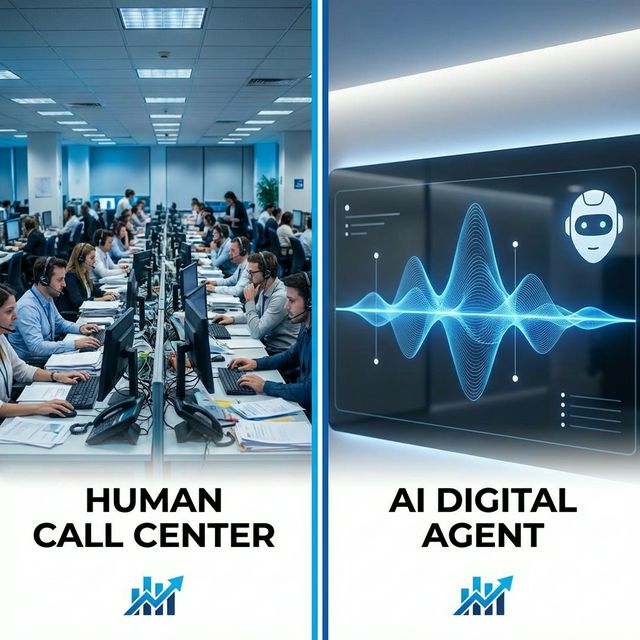
A single confirmation call before dispatch is one of the oldest fixes in Indian e-commerce. The problem has always been scale. A human calling team cannot ring every COD order within minutes of checkout, in the customer's language, at 10 pm during a festive sale. That is where voice AI calling comes in.
Key Takeaway
A voice AI COD verification call confirms intent, catches wrong or incomplete addresses, flags likely fake orders and offers a prepaid incentive, all before the parcel leaves the warehouse. Brands that verify COD orders systematically typically see a meaningful drop in RTO on the verified cohort, and the cost of a short AI call is usually a small fraction of the forward-plus-reverse shipping cost of a single failed delivery.
Why COD Orders Turn Into RTO
RTO is rarely random. Most failed COD deliveries trace back to a handful of causes that a short conversation can surface early:
- Impulse or accidental orders: the customer ordered on a whim from a social ad and changed their mind by the time the courier arrived.
- Incomplete or wrong addresses: missing landmarks, wrong pincodes and flat numbers, which are common in semi-urban India.
- Duplicate orders: the same customer placed two orders because the first confirmation page did not load.
- Fake or prank orders: orders placed with someone else's number or a made-up name.
- Cash not available: the customer is not home or does not have cash on the delivery day.
- Price or expectation mismatch: the customer did not realise the shipping charge, the size or the delivery timeline.
Each of these costs the brand forward shipping, reverse shipping, packaging, blocked inventory and sometimes damaged goods. A verification call that takes under a minute addresses all of them.
How a Voice AI COD Verification Call Works
Trigger on order creation
Your store (Shopify, WooCommerce, a custom stack or a marketplace feed) sends a webhook when a COD order is placed. The AI agent calls within minutes, while the purchase is still fresh in the customer's mind.
Confirm the order in the customer's language
"Namaste, aapne abhi humari website se ek order kiya hai..." The agent reads out the product, amount and delivery city, and asks for a clear yes or no. It detects Hindi, Hinglish, Tamil, Telugu or other languages and switches accordingly.
Fix the address and capture landmarks
If the pincode and city do not match, or the address is thin, the agent asks for a landmark or alternate number and writes it back to the order.
Offer a prepaid switch
Optionally, the agent offers a small discount or faster dispatch if the customer pays now, and sends a UPI payment link on WhatsApp or SMS during the call.
Tag the order and route
Outcomes such as Confirmed, Cancelled, Address Updated, Converted to Prepaid, Not Reachable and Suspicious are written back so your OMS can dispatch, hold or cancel automatically.
Voice AI vs IVR vs Human Calling for COD Confirmation
| Factor | Press-1 IVR | Human team | Voice AI agent |
|---|---|---|---|
| Speed after order | Instant | Hours, sometimes next day | Minutes |
| Address correction | Not possible | Yes | Yes, written back automatically |
| Handles "kab aayega?" questions | No | Yes | Yes, from order and courier data |
| Festive sale peaks | Scales | Needs temporary hiring | Scales |
| Regional languages | Pre-recorded only | Depends on staffing | Multiple languages with code-switching |
| Prepaid conversion pitch | Limited | Inconsistent | Consistent, every call |
Traditional IVR confirmation ("press 1 to confirm") is cheap but blunt. Many customers hang up, press the wrong key, or simply cannot tell you that their address is missing a landmark. For a fuller breakdown of the three approaches, see AI voice agent vs IVR vs telecaller.
Risk-Based Calling: Do Not Call Every Order the Same Way
The best COD programmes do not treat every order equally. They score orders on RTO risk and adjust the flow:
- Low risk (repeat customer, clean address, good pincode history): a WhatsApp confirmation may be enough.
- Medium risk (first-time buyer, moderate order value): a short AI confirmation call.
- High risk (high-RTO pincode, mismatched name and number, very high value, multiple recent orders): AI call with address verification and a stronger prepaid incentive; hold dispatch if unreachable after a set number of attempts.
Pairing calls with WhatsApp follow-ups raises reach further: if the customer does not pick up, a WhatsApp message with Confirm and Cancel buttons often gets a response within the hour.
What to Look for in a COD Verification Voice AI Solution
Low latency
Long pauses make customers think it is a spam robocall. Look for natural turn-taking and barge-in support.
Indian language depth
Hindi and Hinglish at a minimum; Tamil, Telugu, Kannada, Bengali and Marathi if you sell nationally. See our guide to Indian-language voice AI.
Native store integrations
Webhooks from your storefront and write-back of tags and addresses, so ops teams do not copy-paste from a dashboard.
Compliant telephony
Transactional calls should come from correctly registered numbers under TRAI's commercial communication framework. Our TRAI and RBI calling rules explainer covers DLT basics.
Short-call pricing
COD calls are short. Per-second billing or per-call pricing matters more here than in collections. See AI calling pricing in India.
Clear analytics
RTO by verification outcome, pincode and campaign, so you can prove the impact and tune the risk rules.
Designing a COD Verification Script That Customers Do Not Hang Up On
The first five seconds decide whether the customer stays on the line. Unknown numbers are often ignored or cut quickly in India because of spam fatigue, so the opening must establish legitimacy immediately: the brand name, the product and the fact that the customer just placed the order. "Namaste Priya ji, main ABC Store se bol rahi hoon, aapke abhi ke order ke baare mein" works far better than a generic greeting.
- Keep it short: confirmation, address check and optional prepaid offer should fit comfortably inside a minute for most calls.
- Ask closed questions first: "Kya aap yeh order confirm karna chahenge?" gets a clear yes or no before any open-ended address questions.
- Make cancelling easy: a customer who wants to cancel should be able to do so in one sentence. Every honest cancellation is an RTO you did not pay for.
- Do not oversell: mention the prepaid offer once. Pushing hard can make a genuine customer cancel.
- Answer common questions: delivery timeline, return policy, size exchange and whether the delivery agent carries change are the usual ones.
- Use a recognisable number: a consistent, registered business number improves pick-up rates over time as customers learn to recognise it.
Common Mistakes Brands Make With COD Verification
Calling too late
A call the next morning reaches a customer who has already forgotten the impulse purchase. Call within minutes, and retry within the same day.
Auto-cancelling unreachable orders
Unreachable is not the same as unwilling. Hold, retry and use WhatsApp before cancelling medium-risk orders.
Ignoring the data
Call outcomes are a goldmine for risk rules. Feed pincode, cancellation reason and repeat behaviour back into order scoring every week.
One language for all
A Hindi-only bot calling customers in Tamil Nadu or Kerala will see lower engagement. Route by language preference and pincode.
A typical rollout takes a few weeks: connect the storefront webhook, agree the outcome tags with your operations team, localise the scripts, run a holdout test on a slice of orders, then expand once the RTO difference is clear.
Handling Festive and Sale Peaks
Diwali, end-of-season sales and large marketplace events can multiply COD order volume several times over within days, often with a higher share of first-time and impulse buyers, which is exactly when RTO risk rises. Hiring and training temporary calling staff for a two-week spike is slow and expensive, and quality usually suffers. A voice AI agent simply scales concurrency up for the peak and back down afterwards, keeps calling late into the evening when shoppers are most active, and applies the same verification rules to the ten-thousandth order as to the first. Plan peak capacity, retry schedules and WhatsApp fallbacks with your vendor a few weeks before the sale, not on the day.
Measuring Impact: The Metrics That Matter
To prove ROI, run a controlled test. Hold out a random slice of COD orders from verification for a few weeks and compare:
- RTO rate on verified versus unverified orders
- Reach rate: share of COD orders where the call or WhatsApp got a response
- Cancellation at confirmation: orders cancelled before dispatch (each is an RTO avoided)
- Prepaid conversion rate from the call offer
- Address update rate and delivery success on updated addresses
- Cost per RTO avoided: total verification cost divided by the reduction in RTO count
Do not over-filter. If the verification flow cancels too aggressively, you lose genuine customers who simply missed the call. A good rule is to hold rather than cancel unreachable medium-risk orders, and retry at a different time of day.
Beyond COD: Post-Delivery and Receivables Use Cases
The same voice AI stack is useful across the e-commerce lifecycle: NDR (non-delivery report) calls to reschedule failed attempts, return-reason capture, and, for B2B marketplaces and wholesale platforms, payment reminders on credit extended to retailers. CarmaOne's e-commerce solutions bring AI calling, WhatsApp and receivables tracking together, and the collections side runs on CARMA Recover, our collections platform.
Verify Every COD Order Before It Ships
Launch AI confirmation calls in Hindi, Hinglish and regional languages, with address fixes and prepaid nudges written straight back to your store.
See CarmaOne AI Calling