Most lenders in India collect more data about a borrower in the two weeks before sanction than in the two years after it. Bureau reports, GST returns, bank statements, field verification, promoter interviews: all of it is pulled, analysed, and then filed away the moment the loan is disbursed. From that point the only signal most portfolios track is days past due, which by definition tells you about a problem only after the borrower has already missed a payment.
Post-disbursement monitoring is the discipline of keeping that underwriting data alive: refreshing it on a schedule, reading changes as signals, scoring and tiering those signals, and routing them to the right action before an account becomes a non-performing asset. This guide lays out the framework an NBFC credit or risk team can implement, including the RBI context, a signal catalogue grouped by source, a tiering model, cadence by product, the link to collections, metrics, governance and the build-versus-buy decision.
For the broader case for AI-driven early warning, see our guide on AI early warning systems for NPA prevention. This is the operational companion: what to monitor, how often, and what to do when a signal fires.
Post-Disbursement Monitoring: The Essentials
- SMA-0 / SMA-1 / SMA-2 — RBI's special mention account buckets at 1-30, 31-60 and 61-90 days overdue; NPA at 90+
- 7 signal families — bureau, GST, banking, repayment, field, legal and news, sector
- 3 tiers — watch, act, escalate, each mapped to a defined owner and action
- Weeks to months — the typical lead time GST, banking and bureau signals give over DPD
- Product-specific cadence — monthly for unsecured MSME, per-invoice for supply chain finance, quarterly for secured
- Closed loop — every signal ends in a collections, credit or legal action with an outcome recorded
Why Underwriting Data Should Not Die at Sanction
At sanction, the lender holds a complete, point-in-time picture of the borrower: declared turnover, filing discipline, average bank balance, existing obligations, buyer concentration, the state of the shop on the day of the CPV visit. Every one of those variables keeps changing for the life of the loan. A borrower whose GST turnover falls 30% over two quarters and who has taken three new fintech loans is a materially different credit from the one sanctioned, even if every EMI has been paid so far.
The economics are simple. A soft call at SMA-0 costs a few rupees; a field visit, restructuring or legal filing after 90 days costs orders of magnitude more, and recovery rates fall with every bucket an account slips through. Monitoring moves the first intervention earlier. It also feeds origination: the signals that precede default in your own book are the best input for tightening the underwriting process.
The RBI Context: EWS, SMA Classification and Scale Based Regulation
Early warning signals and red-flagged accounts
The Reserve Bank formalised early warning signals (EWS) and red-flagged accounts (RFA) for commercial banks in its 2016 Master Directions on fraud classification and reporting, which listed indicative EWS such as bouncing of high-value cheques, delays in submitting stock statements, frequent ad hoc sanctions, funding interest through additional facilities, and significant reduction in turnover. Those were superseded in 2024 by the Master Directions on Fraud Risk Management, issued separately for commercial banks and for NBFCs (including housing finance companies), which require a board-approved fraud risk policy, an EWS framework and timely reporting. The current texts are on the RBI Master Directions page.
SMA buckets under the IRACP norms
The prudential norms on income recognition, asset classification and provisioning (IRACP) require lenders to classify incipient stress as special mention accounts: SMA-0 for principal or interest overdue 1-30 days, SMA-1 for 31-60 days and SMA-2 for 61-90 days, with NPA at 90 days. RBI's November 2021 clarification made the day-end process explicit and confirmed the same classification applies to NBFCs; larger exposures are reported to CRILC. The master circulars and notifications are on the RBI Master Circulars page and notifications archive.
The important design point: SMA is a lagging classification. It is mandatory, it must be accurate, and your monitoring framework should produce it automatically. But a framework that stops at SMA has only reproduced DPD with new labels. Early warning means acting before SMA-0.
Scale Based Regulation expectations
Under RBI's Scale Based Regulation framework for NBFCs (introduced in 2021 and consolidated into Master Directions in 2023), expectations rise with the layer: middle and upper layer NBFCs need a Chief Risk Officer, board-level risk committees, internal capital adequacy assessment and stronger credit monitoring. Supervisors increasingly ask not just whether SMA is classified correctly, but whether there is a documented process to detect stress earlier and evidence of action on it.
The Signal Catalogue: What to Monitor, Grouped by Source
1. Bureau refresh and enquiries
- • New hard enquiries, especially clusters of 3+ in 30 days (credit hunger, loan stacking)
- • New unsecured tradelines opened after your disbursement, and total obligations rising past the FOIR assumed at sanction
- • DPD on other lenders' accounts while your account is current (you are being prioritised, for now)
- • Score drop beyond a threshold (for example 40+ points in a quarter), settlements, written-off flags
- • For entities: CMR rank deterioration, new charges on MCA, guarantor's own bureau stress
2. GST filing and turnover
- • GSTR-3B filed late, or not filed, for one or more periods after a history of timely filing
- • Declared turnover down 20-30% versus the trailing six-month or same-period-last-year average
- • Consecutive nil returns; GSTIN status moving to suspended or cancelled
- • Buyer concentration rising, loss of a top buyer, or a top buyer whose own GSTIN turns inactive
- • ITC claims rising while output stays flat (inventory build-up), or mismatches with supplier filings
3. Bank statement signals via Account Aggregator
- • Average bank balance falling below the EMI multiple used at sanction
- • Inward cheque or NACH bounces to any lender, including those that were later cleared
- • Credits falling away from GST turnover; sudden rise in cash deposits or round-figure transfers
- • New EMI debits to lenders you did not know about; salary or vendor payments becoming irregular
- • Balance drawn to near zero on the day before your EMI date, repeatedly
Recurring AA consent allows scheduled statement pulls without troubling the borrower; see our guide on bank statement analysis for the metrics.
4. Repayment behaviour on your own book
- • Payment date drifting later within the grace period month on month
- • Switch from auto-debit to manual payment, or a mandate cancellation request
- • Partial payments, requests for date changes, or first-time bounce followed by same-day re-presentation success
- • For revolving lines: utilisation stuck near 100%, limit not swept down for 90+ days
5. Field and CPV re-verification
- • Business premises found closed, relocated, or operating at visibly lower activity than at origination
- • Stock and staff levels inconsistent with declared turnover; hypothecated machinery not on site
- • Phone numbers unreachable, change of residence not intimated, neighbours reporting the owner has left
- • Geo-tagged photos and timestamps from a re-CPV compared with the original CPV record
Read more in our explainer on contact point verification.
6. Legal, news and MCA
- • New litigation against the borrower or promoter: cheque bounce cases, recovery suits, NCLT petitions
- • New charges registered on MCA by other lenders; change in directors or registered office; filings going overdue
- • CERSAI entries on assets you believed were unencumbered; adverse media or enforcement news
7. Sector and geography stress
- • Rising early delinquency in the same HSN or NIC cohort across your own book
- • Pin-code level flood, strike, demolition or market-closure events
- • Anchor-level stress in supply chain finance: anchor payment delays to multiple suppliers at once
Scoring and Tiering Signals: Watch, Act, Escalate
Individual signals are noisy. A single late GST filing may be an accountant on leave. The framework works when signals are weighted, combined into a borrower-level stress score, and mapped to a tier with a defined owner and action. A simple, explainable approach beats a black box here, because the output has to be defended to a credit committee and, eventually, to an auditor.
| Tier | Typical trigger pattern | Owner | Action and SLA |
|---|---|---|---|
| Watch | One moderate signal: a late filing, a score dip, ABB softening, a couple of new enquiries | Automated, with portfolio analyst review | Increase refresh frequency; soft WhatsApp or voice touchpoint; re-check in 30 days |
| Act | Two or more signals across sources, or one severe signal: a bounce to another lender, turnover down 30%, a new unsecured loan stack | Credit monitoring officer and pre-collections team | Call within 3 working days, structured conversation on cash flows, re-CPV if premises-related, decision on limit freeze for revolving lines |
| Escalate | Premises closed, GSTIN cancelled, litigation filed, promoter unreachable, or SMA-1 reached alongside other signals | Credit head, collections head, legal | Field visit within 7 days, restructuring or recall assessment, security perfection check, legal notice readiness |
Weights should come from your own history: run the catalogue retroactively over accounts that became NPA in the last 24 months and a matched set that stayed current, keep the signals that separate the two, calibrate by product and ticket size, and re-validate every six months.
Monitoring Cadence by Product
| Product | Bureau | GST | Banking (AA) | Field / CPV | Legal / MCA |
|---|---|---|---|---|---|
| Unsecured MSME term loan | Monthly (soft pull) | Monthly, after filing due date | Monthly | On trigger; annual sample | Quarterly |
| Working capital OD / CC | Monthly | Monthly | Continuous (own account) plus monthly AA for other accounts | Stock audit quarterly or half-yearly | Quarterly |
| Supply chain / invoice finance | Quarterly on supplier; monthly on anchor | Per invoice (e-invoice and GSTR-1 match) | Per settlement cycle | On trigger | Monthly on anchor |
| Secured term loan / LAP | Quarterly | Quarterly | Quarterly | Annual property and premises check | Half-yearly, plus CERSAI check |
Accounts in the Act or Escalate tier move to a tighter cadence automatically. To manage bureau costs, many NBFCs use a portfolio-review product monthly and a full report only on trigger.
Linking Early Warning Signals to Collections Actions
A signal that does not end in an action is a report, not a system. The escalation ladder below is the standard shape; the point is that the first rungs happen before any EMI is missed and are handled by a pre-collections or relationship team rather than hard collections.
Soft reminders
Watch tier. WhatsApp, SMS, voice-bot or relationship manager call framed as a check-in, timed before the EMI date. Confirm mandate and balance.
CPV revisit
Act tier. Field re-verification of premises and stock, structured cash-flow conversation, updated contact details. Output feeds back into the stress score.
Restructuring or limit action
Escalate tier with viable business. Tenure extension, EMI re-phasing, moratorium within RBI norms, freeze or reduce revolving limits, security top-up.
Legal
Escalate tier with non-cooperation or fraud indicators. Demand notice, Section 138 for bounced instruments, SARFAESI or arbitration as applicable, security enforcement.
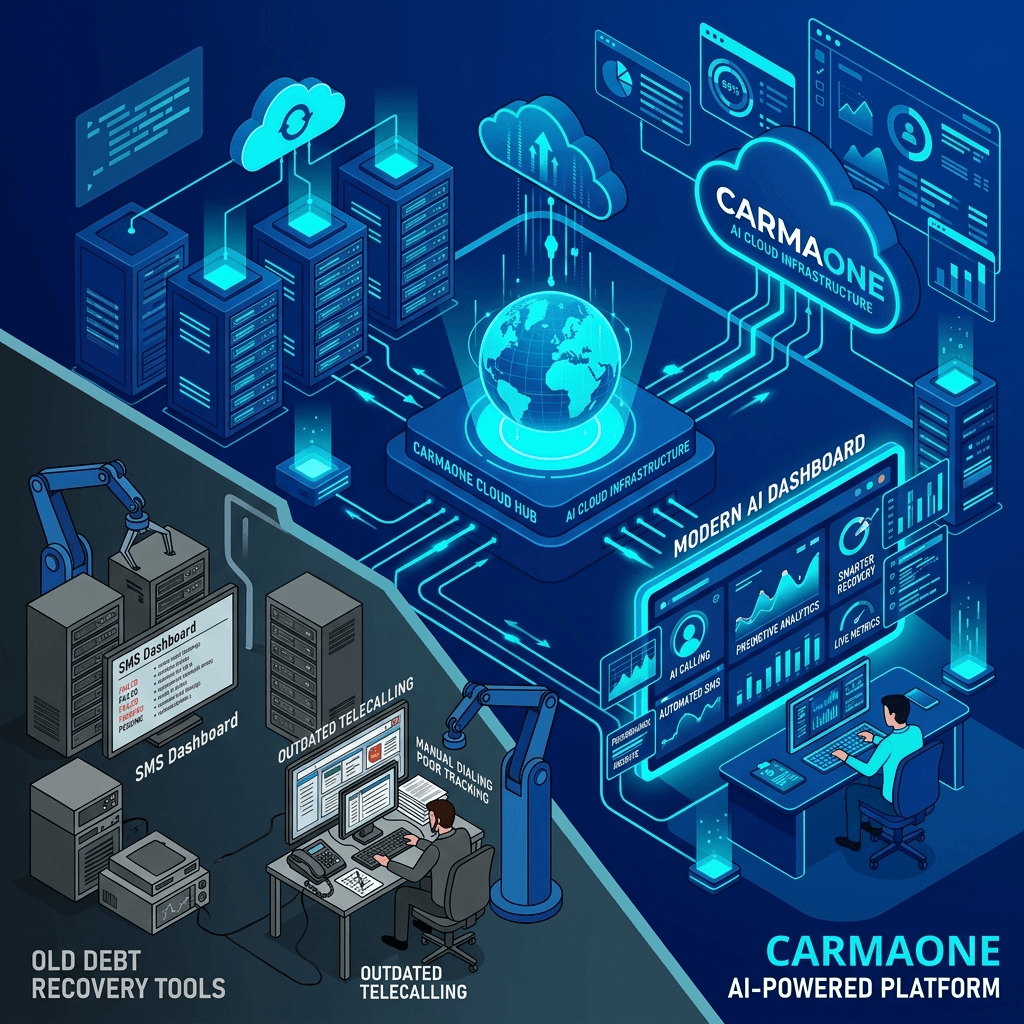
In practice the monitoring engine must write directly into the collections system: creating a case, setting the strategy, assigning the agent and logging the outcome. CARMA Recover is built for this hand-off, with strategy routing by tier, omnichannel reminders, field allocation and legal workflows in one queue. For the collections side, see how to reduce NPAs with a tiered collection strategy.
Dashboard and Metrics That Prove the Framework Works
- Signal coverage: Share of the live book with a bureau, GST and banking refresh inside the cadence window. Gaps here usually mean expired AA consents or missing GSTINs.
- Lead time: Median days between the first Act-tier signal and the first missed payment, for accounts that went on to miss one. This is the number that justifies the programme.
- Precision of tiers: Of accounts flagged Act or Escalate, the share that reached SMA-1 or worse within 90 days. Too low and the team drowns in false alarms; too high and you are catching stress too late.
- Roll rates by tier: Current to SMA-0, SMA-0 to SMA-1, SMA-1 to SMA-2, SMA-2 to NPA, split by whether an action was taken within SLA.
- Action SLA adherence and outcomes: Percentage of signals actioned within SLA, and the resolution recorded (paid, promise kept, restructured, escalated).
- Cure rate of pre-SMA interventions: Share of Act-tier accounts that stayed current for the next 6 months after intervention.
Governance: Who Owns Post-Disbursement Monitoring
The framework needs a policy, an owner and an audit trail. Typically:
- Board or risk committee approves the monitoring policy, the signal catalogue, tier definitions and SLAs, and reviews portfolio-level metrics quarterly.
- Chief Risk Officer or credit head owns thresholds, calibration and exceptions, and signs off on changes to the model.
- Portfolio monitoring unit runs the engine day to day, reviews Watch-tier output, and hands Act and Escalate cases to collections and legal.
- Collections and legal own actions and outcome logging within SLA.
- Internal audit tests that signals were generated, actioned and documented, and that SMA and NPA classification match the system of record.
Consent and conduct matter as much as model accuracy: recurring AA consent must be scoped and renewed properly, post-disbursement bureau pulls must be of the permitted type, and Watch-tier outreach must follow RBI's fair practices norms. When a supervisor asks how you detect incipient stress, the answer should be a policy document and a dashboard.
Building vs Buying a Monitoring Engine
| Consideration | Build in-house | Buy a platform |
|---|---|---|
| Data connectors (bureau, GSTN, AA, MCA, courts) | Each integration is a separate project with its own compliance and maintenance burden | Pre-built and maintained; onboarding is configuration |
| Signal logic and scoring | Fully custom, but needs a data science team to calibrate and re-validate | Starter catalogue and weights, tuned on your book; explainability built in |
| Time to first value | Typically 6-12 months | Typically 4-10 weeks |
| Best fit | Large NBFCs with mature engineering and a differentiated data strategy | Most small and mid-sized NBFCs, and large ones that want connectors and workflow handled |
How CarmaOne Closes the Loop from Underwriting to Recovery
CARMA Assess keeps the underwriting data from sanction alive after disbursal: scheduled bureau, GST and Account Aggregator refreshes, re-CPV scheduling through the CPV workflow, legal and MCA watch, and a configurable stress score with Watch, Act and Escalate tiers that your credit team can explain and defend. Signals flow straight into CARMA Recover, where strategy routing, reminders, field allocation, restructuring cases and legal steps run from one queue, with every outcome written back to the account on CARMA Core. The result is one record per borrower from eligibility screening (see our MSME loan eligibility and underwriting checklist) through monitoring and recovery.
The lenders closing the MSME credit gap profitably are not the ones with the loosest underwriting. They are the ones that know, every month, which borrowers are drifting and act while the conversation is still easy.
See Stress Before It Becomes SMA
CARMA Assess monitors bureau, GST, banking, field and legal signals after disbursal and hands them to CARMA Recover for action, so your team intervenes weeks earlier at a fraction of the cost.