India's private credit market has grown faster than the software running it. Funds deploying thousands of crores are still tracking covenants in Excel, voting on investment committee decisions over email, and rebuilding LP reports by hand every quarter.
That gap exists for a specific reason. The mature platforms in this category — Allvue Systems, Black Mountain, S&P Global's iLEVEL, Oxane Partners — were built for global managers and priced accordingly. The Indian software market, meanwhile, has poured its energy into lending: loan origination and collections have dozens of credible vendors. Private credit fund operations has almost none.
This guide compares what is actually available to an Indian fund in 2026, what each platform is genuinely good at, and — more usefully — how to work out which category of tool your fund needs before you start taking demos.
The short version
- • Running a large, multi-strategy global book? Allvue or iLEVEL. The depth is real and you will use it.
- • Need heavy structured-credit and securitisation analytics? CardoAI or Oxane Panorama.
- • Primarily a CRM and pipeline problem? A relationship-intelligence tool solves it far cheaper than a fund platform.
- • A SEBI-registered AIF or NBFC lending against Indian borrower data? This is where global platforms fit worst, because their data model assumes Western reporting conventions.
- • Still on spreadsheets? Your real competitor is not any vendor below — it is your current process, and almost anything beats it.
First, decide which problem you are solving
Most failed software selections in this category come from conflating four genuinely different problems. Funds buy a portfolio-monitoring platform to fix a pipeline-tracking problem, or a CRM to fix a covenant-monitoring problem, and conclude the software was bad.
The four are:
- Deal sourcing and pipeline. Where deals come from, what stage they are at, why they died. Fundamentally a CRM problem.
- Investment committee workflow. Memo preparation, circulation, voting, conditions precedent, audit trail. A document and approval-workflow problem.
- Portfolio and covenant monitoring. Ingesting borrower data after disbursement and testing it against covenants. A data-pipeline problem, and the hardest of the four.
- Fund accounting and LP reporting. Capital accounts, waterfalls, IRR/MOIC/TVPI, investor statements. An accounting problem.
Very few platforms are strong at all four, and the ones that claim to be are usually strongest at whichever they started with. Work out which of the four is costing you the most today, and weight your evaluation there.
The global institutional platforms
Allvue Systems
Allvue is the most complete platform in the category and the default answer for large private credit managers globally. It spans front-to-back: deal pipeline, portfolio monitoring, covenant and watchlist management, fund accounting and investor reporting, with loan-level data consolidated in one system.
Genuine strengths: breadth is not marketing here. If your fund needs fund accounting and portfolio monitoring in the same system, Allvue actually delivers it. Its loan-level data model handles the complexity of syndicated and structured positions that break simpler tools.
Where it fits badly for Indian funds: cost and implementation weight relative to fund size, and a data model built around Western reporting conventions. If your borrowers submit GST returns and Indian-format financials rather than audited quarterly packs in a standard template, a meaningful part of what you are paying for does not apply, and you will be building custom ingestion anyway.
S&P Global iLEVEL
iLEVEL is institutional-scale private markets monitoring, with flexible data ingestion, portfolio analytics and valuations workflows, backed by managed data services — meaning S&P will do the data collection and normalisation work for you.
Genuine strengths: the managed data service is the differentiator. For funds whose real constraint is that nobody internally has time to chase and normalise borrower submissions, outsourcing that is worth a great deal. Valuations workflow depth is also strong.
Where it fits badly: it is built for institutional scale, and pricing reflects that. It also assumes a reporting cadence — quarterly submissions, standard formats — that is exactly the cadence Indian private credit is trying to move away from.
Black Mountain
Long-established in credit and loan portfolio management, with a reputation for configurability on complex credit structures. The trade-off is the usual one for highly configurable enterprise software: the flexibility is real, and so is the implementation effort required to realise it. Appropriate for funds with dedicated operations and technology capacity.
Oxane Partners (Panorama)
Purpose-built for data management, risk monitoring and reporting across private credit positions, with particular strength in structured credit and real-estate debt. Oxane pairs software with a services layer, which suits funds that want analytical support rather than only a tool. Notably, Oxane has significant delivery presence in India — so the commercial relationship can be easier than with a purely US-based vendor, even though the product is not designed around Indian regulatory structures.
CardoAI
AI-native private debt platform focused on data aggregation, portfolio monitoring and analytics, with real strength in structured credit and securitisation. If your fund's complexity is in the instrument rather than in the borrower — tranching, waterfalls, SPV structures — CardoAI is more directly relevant than a general-purpose fund platform.
Lumonic, Built and Cobalt
Narrower, and useful precisely because of it. Lumonic focuses on portfolio monitoring and covenant tracking for private credit lenders. Built covers loan-lifecycle management with real-time portfolio visibility, with roots in construction lending. Cobalt is strongest on benchmarking and performance analytics. Each solves one of the four problems well rather than all four adequately — which, if you have correctly identified your bottleneck, is an advantage.
Relationship-intelligence CRMs (4Degrees and similar)
If your genuine pain is "we lost a deal because nobody followed up" rather than "we cannot tell if a borrower breached a covenant", a private-credit CRM will fix it at a fraction of the cost of a fund platform. Do not buy portfolio-monitoring software to solve a pipeline problem.
The India gap — and why it is not a marketing point
Every platform above is credible. The issue for an Indian fund is not quality; it is fit, and it shows up in three concrete places.
1. Borrower data looks completely different
A global platform expects a quarterly reporting pack in a broadly standard format. An Indian mid-market borrower generates a different data trail entirely: monthly GST returns, credit bureau records, bank statements accessible through the Account Aggregator framework, and often unaudited management accounts until year end.
That difference matters more than it sounds. GST filing behaviour is one of the most informative early-warning signals available on an Indian borrower — a missed filing frequently precedes payment stress by weeks. A platform with no concept of GST cannot use it, so you end up monitoring on the slowest available signal while the fastest one sits unread.
2. SEBI AIF structures are not fund-agnostic
Category I, II and III AIFs carry distinct reporting obligations, and Indian funds also deal with structures — NBFC co-lending arrangements, security trustee mechanics, Indian security creation and perfection — that a globally-configured platform treats as edge cases requiring custom work. Reporting templates designed for Delaware or Luxembourg structures need rebuilding, not remapping.
3. Enforcement reality differs
When an Indian credit position deteriorates, the available routes are SARFAESI enforcement, the Debt Recovery Tribunal, arbitration, or the IBC before the NCLT — each with its own timeline, threshold and moratorium interaction. A monitoring platform that flags a covenant breach but has no model of what happens next has done a third of the job.
Where CARMA DealFlow fits
We build CARMA DealFlow, so treat this section accordingly — but the honest positioning is narrow rather than broad.
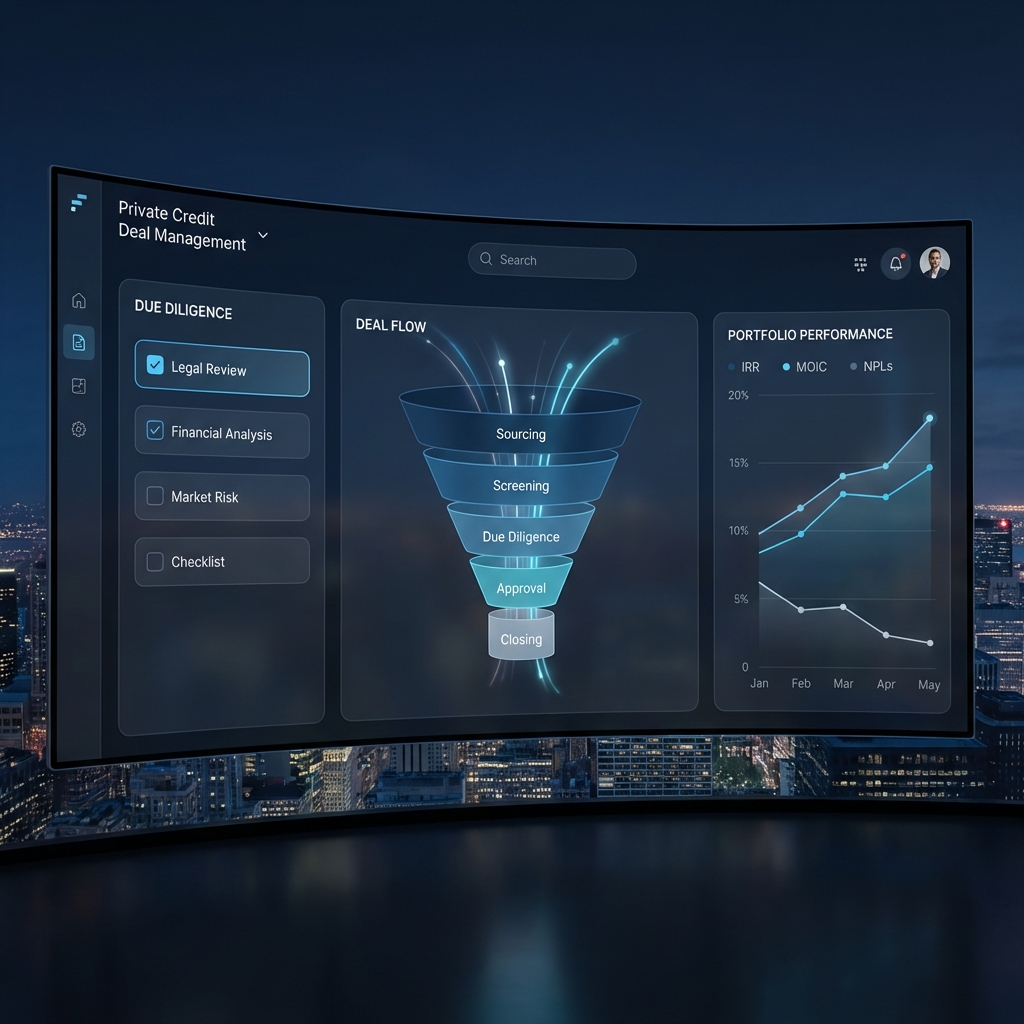
DealFlow covers the same workflow spine as the platforms above: deal sourcing and pipeline, digital IC workflows with secure voting and audit-ready decision logs, automated covenant monitoring, portfolio exposure and concentration limits, and one-click LP reporting with IRR, MOIC and TVPI computed from live deal data. What differs is the data model underneath it.
- Indian borrower data natively. GST filings, bureau behaviour, bank statements and MIS ingested directly and continuously — not quarterly PDFs re-keyed by an analyst.
- SEBI AIF structures as first-class. Category I, II and III reporting built in rather than configured around.
- Shared signals with the credit side. Because CarmaOne also runs origination and collections, the same early-warning indicators used in lending — missed GST filings, bureau score drift, bounced payments — feed covenant monitoring here.
- Weeks to deploy, not quarters. Which matters most for the funds too small to justify a global platform's implementation.
When you should not pick us. If you are a large multi-strategy manager with a global LP base, dedicated fund-operations staff and genuine need for deep fund accounting and valuations workflow, Allvue or iLEVEL are more complete products and you should buy one of them. If your complexity is in securitisation tranching rather than borrower monitoring, CardoAI is more directly built for that. We are the better answer for Indian funds whose covenant tracking currently lives in spreadsheets and whose borrowers file GST returns.
Eight questions to ask on every demo
- What is your covenant-testing latency? How long between a borrower breaching and the system flagging it? If the answer depends on a quarterly submission, the answer is a quarter.
- Show me borrower data ingestion. Not a slide — an actual ingestion running. Ask specifically about GST and bank statement data.
- Who builds a new report template? If the answer is the vendor's professional services team, price that in and add it to every timeline.
- How are IRR, MOIC and TVPI calculated? From live deal data, or from a separately maintained spreadsheet that someone updates? This is the most common gap between demo and reality.
- What does the IC audit trail actually capture? You need who voted, when, on which version of the memo, with what conditions attached.
- How do concentration limits get enforced? Alerting after the fact is very different from blocking at approval.
- What is the total first-year cost? Licence plus implementation plus data services plus the internal headcount to run it.
- Name three funds of my size and structure using this. Reference customers at 10x your AUM tell you nothing about your implementation.
The honest conclusion
There is no single best private credit platform for Indian funds, and any guide claiming otherwise is selling something. There is a reasonably clear mapping:
- Large, global, multi-strategy: Allvue or iLEVEL.
- Structured credit and securitisation-heavy: CardoAI or Oxane Panorama.
- Configuration-heavy with in-house tech capacity: Black Mountain.
- Single-problem focus: Lumonic for covenants, Built for loan lifecycle, Cobalt for benchmarking, a CRM for pipeline.
- India-first, SEBI AIF, Indian borrower data: CARMA DealFlow.
And one point that applies to every fund reading this: if you are currently on spreadsheets and quarterly PDFs, the gap between your process and any of these platforms is far larger than the gap between the platforms. Do not let a long evaluation become the reason you spend another four quarters finding out about breaches a quarter late.
See covenant monitoring on live Indian borrower data
CARMA DealFlow ingests GST filings, bureau records and bank statements continuously, and tests them against your covenant package — so a breach surfaces in days, not next quarter.
Explore CARMA DealFlow →