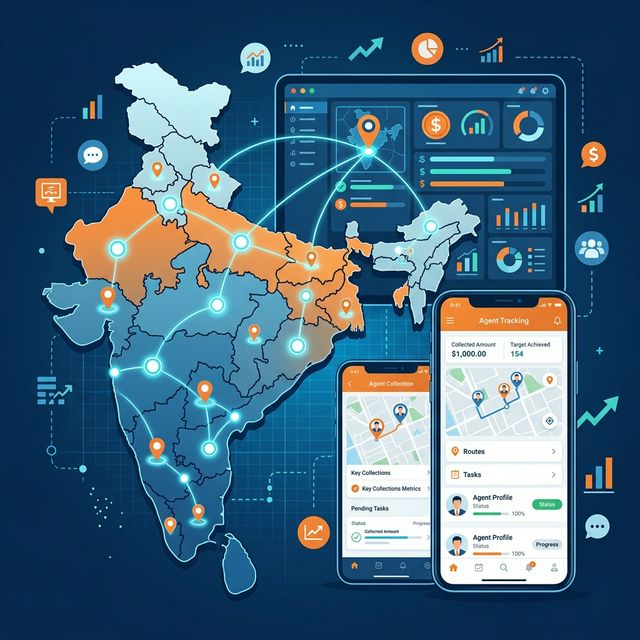
Quick Answer
Effective field collection management in India requires: background-verified agents with KYC documentation, real-time GPS tracking, mobile apps for visit logging, phygital integration with digital channels, and coverage across tier-2/tier-3 cities. For portfolio recovery at DPD 30–90, field operations consistently outperform digital-only approaches in India's semi-urban and rural markets.
India's debt collection problem cannot be solved with a smartphone app alone. While fintech platforms celebrate UPI adoption and WhatsApp penetration, the reality on the ground in Gorakhpur, Coimbatore, Nashik, and Patna tells a different story. Borrowers here do not always answer AI calls. Many still prefer — and respond to — a face-to-face conversation. In tier-2 and tier-3 cities, where social accountability runs deep and personal relationships carry weight, field collection management software is not a legacy relic. It is a competitive necessity.
The structural reality of India's credit market is asymmetric. Lenders have digitized rapidly. Borrowers have not. Smartphone penetration in rural and semi-urban India sits well below the national headline figures. Feature phone usage remains widespread. Literacy barriers mean many borrowers struggle with WhatsApp messages, payment links, or digital receipts. When an EMI is missed in these markets, the only collection channel that consistently works is a verified, trained, and compliant field agent who speaks the local language and shows up at the right door.
For NBFCs, microfinance institutions, and banks scaling across India's geographically diverse lending markets, the question is not whether to run field operations — it is how to do so at scale, in full compliance with RBI guidelines, and with the technology infrastructure to make every visit measurable, auditable, and cost-effective. This guide covers exactly that.
Field Collections in India: Key Data Points (2026)
- ₹2.4 lakh crore+ — Estimated gross NPA in NBFC sector requiring active recovery (RBI Annual Report 2025)
- 38% — Share of Indian borrowers in tier-2/tier-3 cities who say they prefer in-person contact for financial discussions
- DPD 30–90 — Window where field visits deliver 2–3x higher promise-to-pay conversion vs digital-only
- 14,000+ — Pin codes in India requiring active field collection coverage for full-portfolio management
- 35% — Average recovery rate improvement when phygital (field + digital) model replaces digital-only in semi-urban markets
- 22+ states — Geographic coverage required for lenders with diversified retail loan books across India
Why Field Collections Remain Irreplaceable in India
The Digital Penetration Reality
National-level statistics on India's digital adoption are misleading. Yes, India has over 500 million UPI users. Yes, WhatsApp has 500+ million Indian users. But when you segment by geography, the picture changes dramatically. In tier-2 and tier-3 cities, active smartphone usage with consistent data connectivity — the baseline requirement for digital collections — is present in roughly 55–60% of the adult population. In rural districts, that figure drops further. The borrowers lenders are trying to reach at DPD 45 or DPD 60 are disproportionately located in these lower-penetration zones. They may have received the loan via a DSA or branch, not a mobile app. They may pay EMIs in cash at a collection point. Assuming they will respond to an AI call or a WhatsApp payment link is not a collections strategy. It is wishful thinking.
Borrower Psychology and Personal Accountability
Cultural and psychological dynamics in India make in-person contact uniquely effective for debt recovery. In many communities, especially in semi-urban and rural areas, social reputation and community standing are powerful motivators. The presence of a field agent — professionally dressed, carrying proper identity documentation, speaking the local language — signals institutional seriousness. Borrowers who had been ignoring phone calls frequently engage, explain their situation, and commit to a repayment plan when visited in person. This is not harassment. It is the social accountability mechanism that has driven microlending in India for decades. Properly managed, field visits are among the most humane and effective collection interventions available.
The Promise vs. Payment Gap
Digital collections generate promises. Field collections generate payments. This distinction is not rhetorical — it shows up directly in conversion data. An AI calling campaign at DPD 45 might achieve a 25–30% promise-to-pay rate. But of those promises, only 40–50% convert to actual payment within the commitment window. By contrast, field visits at the same DPD stage generate lower raw promise rates (because the agent only visits a subset of borrowers), but conversion from promise to payment runs at 65–75%. The reason is simple: a field agent can present a UPI QR code and collect payment on the spot. Digital channels cannot. For lenders managing loan books above ₹1–2 lakh per ticket, this conversion gap has enormous economic impact.
RBI Compliance and Permitted Field Operations
A common misconception among digital-first lenders is that RBI regulations discourage or prohibit field collections. This is incorrect. The RBI Fair Practices Code for NBFCs and the guidelines for recovery agents explicitly permit field visits — provided they are conducted during permitted hours (7 AM to 7 PM), by identified and verified agents, without harassment, intimidation, or threat. When done correctly, field collection is fully RBI-compliant and represents legitimate and expected industry practice. The challenge is enforcement and documentation, which is where technology plays a critical role.
The Phygital Model
The most effective collections operations in India in 2026 do not choose between digital and field — they run both in an orchestrated sequence. Digital channels handle early-stage communication, DPD 1–30 nudges, and post-visit follow-up. Field agents handle the mid-stage conversations, DPD 30–90, where personal engagement shifts the outcome. This phygital model — physical + digital, coordinated by a central platform — is what separates high-performing collections operations from average ones. The omnichannel collections strategy that India's top NBFCs now deploy starts with AI and WhatsApp, escalates to field, and never treats any channel in isolation.
The Compliance Challenge in Field Collections
Field collection is among the most heavily regulated activities an NBFC or bank can undertake. The RBI, state consumer protection authorities, and increasingly active borrower advocacy groups have made compliance non-negotiable. Violations — even unintentional ones — result in regulatory penalties, media coverage, and reputational damage that can collapse a lender's ability to raise capital or partner with co-lenders.
RBI Fair Practices Code Requirements
The RBI's Fair Practices Code requires all regulated entities to ensure that their recovery agents: operate only during permitted hours; carry proper identification; do not use abusive language, intimidation, or physical force; provide written receipts for any payments collected; and make borrowers aware of their right to lodge complaints. These requirements apply equally to on-roll employees and third-party outsourced agents. Lenders are directly liable for violations by their collection partners under outsourcing guidelines.
What Constitutes Prohibited Conduct
The line between compliant field collections and harassment is clearly defined in regulatory guidance: visiting outside permitted hours, repeated visits on the same day to a single borrower, contacting family members or employers without prior consent, making statements that imply legal consequences that have not been initiated, or any physical intimidation. Lenders must build systems that make these violations impossible, not merely discouraged. Technology — GPS time-stamping of visits, call recordings, mandatory mobile app check-ins — is how this is operationally enforced.
Background Verification Requirements for Field Agents
Before any field agent visits a borrower's address, they must pass a comprehensive background verification process. Industry best practice — and increasingly, regulatory expectation — requires: criminal record verification through court database checks; police verification from the agent's home district; permanent address verification with physical confirmation; previous employment verification covering the prior 3–5 years; and identity documentation verification (Aadhaar, PAN, driving license). Agents with any history of financial fraud, harassment complaints, or criminal convictions should be categorically excluded. This verification must be renewed annually and triggered by any escalated borrower complaint.
KYC for Field Agents: Digital Identity and Virtual ID Cards
Every deployed field agent must carry verifiable identity that borrowers can authenticate. Best practice in 2026 involves issuing digital identity cards through the lender's platform — QR-code enabled cards that borrowers can scan to verify the agent's name, photograph, employer institution, and authorization scope. This eliminates impersonation risk and gives borrowers an immediate way to validate who is at their door. The KYC records, including face-match photo verification at onboarding, must be maintained in the lender's central compliance system with full audit trails.
Training and Certification Requirements
Field agents must complete formal training before deployment covering: RBI guidelines on fair practices; prohibited actions and communications; local language communication protocols; payment collection procedures; escalation workflows; and emergency procedures for hostile situations. Training must be documented, tested, and certified. Re-certification should occur at minimum annually and following any compliance incident. Agents who fail re-certification cannot be deployed until remediation is complete.
Continuous Monitoring and Compliance Scoring
Compliance is not a one-time event. Lenders must implement ongoing monitoring mechanisms: supervisor audit visits (unannounced spot checks on agent behavior); borrower feedback surveys after every field visit; complaint tracking and root-cause analysis; GPS-based visit time verification; and call recording review for any telephonic interactions during or after field visits. Agents should receive a running compliance score that determines their deployment eligibility and, where applicable, their variable compensation.
Building a Verified Field Agent Network Across India
Geographic coverage is the defining operational challenge of field collections at scale. India's credit market spans 22+ states, hundreds of districts, and thousands of pin codes where borrowers live and work. Building reliable collection coverage across this terrain — while maintaining the verification and compliance standards described above — is a formidable logistics problem.
The Coverage Challenge
A mid-sized NBFC with ₹500 crore AUM and a geographically diverse loan book may have active borrowers in 300–400 distinct pin codes. Many of these will be tier-2 and tier-3 cities with no local branch presence. Deploying on-roll field agents to every location is economically impossible. The practical solution is a hybrid network: on-roll agents in high-concentration zones, and a verified partner network for tail coverage.
On-Roll vs. Outsourced Field Agents
On-roll field agents offer the highest compliance control. They are directly employed, directly supervised, and directly trained. Their behavior is fully within the lender's management scope. The trade-off is cost and inflexibility — on-roll agents require fixed salary costs regardless of portfolio density in their area. For high-volume urban or semi-urban clusters with consistent monthly delinquency flows, on-roll agents offer the best economics. For tail geographies or low-density zones, outsourcing to verified partner agencies allows flexible scaling without fixed overhead. Critically, under RBI outsourcing guidelines, lenders remain fully responsible for partner agent conduct. The verification and training standards must be identical.
Partner Collection Agency Networks
Third-party collection agencies can dramatically extend geographic coverage — but they introduce significant compliance risk if not properly managed. Best practice involves: formal empanelment agreements with liability clauses for RBI violations; mandatory adoption of the lender's technology platform for visit tracking; background verification conducted or audited by the lender (not just attested by the agency); regular compliance audits of partner operations; and real-time data sharing so lender supervisors can monitor partner agent activity in the same dashboard as on-roll agents.
Agent Certification and Re-Verification Cycles
Agent rosters are not static. People join and leave collection agencies frequently. The lender must receive proactive notification of any roster change — new agents must be cleared before being assigned to lender accounts; departing agents must be immediately deauthorized in the platform. Annual re-verification, quarterly compliance refreshers, and immediate trigger-based reviews following any complaint are the minimum standards for a defensible compliance posture.
Onboarding, Training, and Managing Agents at Scale
At scale, manual agent onboarding and training becomes a bottleneck. Technology-enabled onboarding — digital KYC, video-based training modules with in-app assessments, e-signature for policy acknowledgments — allows lenders to onboard dozens of agents per week without proportional increase in compliance staff. The same mobile platform used for visit tracking can deliver ongoing training content, compliance updates, and performance feedback directly to field agents' devices.
Technology for Field Collection Management
The difference between a high-performing field collection operation and a liability-generating one is almost entirely technological. Without the right software infrastructure, field collections are a compliance nightmare: unverifiable visit claims, no audit trails, inconsistent borrower communication, and no way to measure agent performance objectively. With the right platform, field operations become measurable, auditable, and continuously improvable.
Real-Time GPS Tracking and Route Optimization
Every field agent must be GPS-tracked from the moment they begin their workday. GPS data serves dual purposes: operational efficiency (route optimization to minimize travel time between visits, reducing per-visit cost) and compliance (timestamped location records that prove visits occurred at permitted hours, at the correct address, for appropriate durations). Route optimization algorithms that factor in borrower priority scoring, agent location, and traffic data can increase productive visits per agent per day by 20–30%.
Mobile App Features for Field Agents
The field agent's mobile app is the operational heart of compliant collections. Essential features include: geo-fenced check-in that confirms the agent is physically at the borrower's address before the visit is logged; borrower identity verification via photo upload or Aadhaar-linked face match; structured visit outcome capture (contact made, disposition, payment commitment, amount collected); digital payment collection via UPI QR code generation in-app; call recording for any phone interactions made during the visit; visit notes and photograph upload for address verification; and immediate supervisor escalation request capability.
Digital Payment Collection in the Field
The ability to collect payment on the spot is a significant advantage of field operations — but it must be handled with full auditability. Agents should never handle cash without a registered receipt system. The preferred model is: the agent generates a UPI payment request or QR code in-app, the borrower scans and pays digitally, the payment confirmation is instantly recorded in the lender's system, and a digital receipt is issued to the borrower via SMS or WhatsApp. This eliminates cash handling risk, provides instant reconciliation, and creates an immutable payment record.
Supervisor Monitoring Dashboards
Supervisors overseeing field teams need real-time visibility without being physically present everywhere. Dashboard requirements include: live map view of all active agents by location; visit progress tracker per agent per day; exception alerts (agent off-route, extended time at location, missed geo-fence check-in, complaint flagged by borrower); daily performance summaries by agent and team; and recovery amount tracking against targets.
Escalation Workflows
Field collection outcomes feed directly into the broader collections workflow. A structured escalation path ensures no account falls through the gaps: field agent visit → outcome logged → if no resolution, supervisor review → secondary field visit or digital follow-up → legal notice trigger at defined DPD threshold. The platform must automate these transitions based on pre-defined rules, not manual supervisor judgment, to ensure consistency and compliance.
Integration with Central Receivable Management Platform
Field operation data has no value in isolation. Every visit outcome, payment collected, borrower contact record, and agent GPS log must sync in real time with the central receivable management system. This integration ensures that digital channels do not contact a borrower immediately after a field agent visit has already collected payment, and that field agents are not dispatched to accounts that have just paid via WhatsApp. Real-time data sync across all channels is the technical foundation of the phygital model.
The Phygital Model: Integrating Field Ops with Digital Collections
The phygital collections model is not simply "use both channels." It is a precisely orchestrated sequence that uses each channel at its optimal point in the borrower journey, with each channel feeding data to inform the next.
Pre-Visit Digital Warming
Before a field agent visits a borrower, the digital sequence should have already been deployed: AI call at DPD +5 to establish first contact and gauge responsiveness; WhatsApp payment reminder with payment link at DPD +10; second AI call with escalation language at DPD +20; SMS notification at DPD +25 indicating that a field representative will be visiting. This pre-warming sequence serves two purposes: it gives digitally-responsive borrowers multiple easy opportunities to resolve before a field visit is needed, and it signals institutional seriousness to borrowers who are intentionally avoiding contact. When the field agent arrives, the borrower has already been primed — they know the visit is coming, they know the outstanding amount, and they have had multiple chances to pay without the in-person encounter.
Post-Visit Digital Follow-Up
Not every field visit results in immediate payment. Some borrowers request additional time, dispute the amount, or are not contactable on the first visit. Post-visit digital follow-up maintains momentum: WhatsApp message summarizing the visit outcome and payment commitment made; AI call at the committed payment date as a reminder; payment link re-sent 24 hours before the committed date; supervisor escalation trigger if commitment is broken. The post-visit digital sequence converts a significant portion of "not paid today" outcomes into eventual payment without requiring a second field visit.
Channel Selection by DPD Stage
The phygital channel matrix operates on a DPD-based logic: DPD 1–15: automated SMS and WhatsApp nudges only; DPD 15–30: AI calling + WhatsApp with payment links; DPD 30–60: field visit trigger for accounts above ₹50,000 ticket size or accounts with no digital engagement in preceding 15 days; DPD 60–90: mandatory field visit for all accounts above threshold, with legal notice preparation running parallel; DPD 90+: legal escalation with field support for asset verification where applicable. This framework prevents over-spend on field operations for accounts that resolve digitally, while ensuring high-value or highly delinquent accounts receive the in-person attention that converts.
Cost Optimization Through Channel Intelligence
The economic logic of the phygital model is straightforward: digital channels cost ₹5–30 per borrower contact; field visits cost ₹300–800 per visit. Using digital to exhaust the responsive borrower population before deploying field agents means field resources are concentrated on accounts where they are genuinely necessary. A lender with 10,000 accounts at DPD 30 might deploy digital channels to 8,000 accounts that show any digital engagement signal, and concentrate field visits on the 2,000 accounts with zero digital response. This segmentation, driven by the platform's engagement data, is what makes phygital economically superior to either channel alone.
Cost Structure of Field Collections
Field collections are more expensive per contact than digital channels — but the relevant comparison is not cost per contact. It is cost per rupee recovered. On that measure, field operations in India are often the most efficient channel available for mid-to-late DPD accounts.
Typical Cost per Field Visit
In India's 2026 cost environment, a single field visit costs between ₹300 and ₹800, depending on geography (urban vs. rural), mode of transport (two-wheeler vs. four-wheeler), account complexity, and whether the visit is via on-roll agent or partner agency. Metro-adjacent areas cost toward the lower end; distant tier-3 districts requiring multi-hour travel cost toward the upper end. Multi-visit routes (where an agent visits 5–8 accounts in a single day) reduce the per-visit cost substantially.
| Channel | Cost Per Contact | Promise-to-Pay Rate | Promise-to-Payment Conversion | Effective Recovery Cost (₹1L loan) |
|---|---|---|---|---|
| AI Calling | ₹8–25 | 22–28% | 40–50% | ₹180–560 |
| ₹5–15 | 15–20% | 35–45% | ₹110–430 | |
| Field Visit | ₹300–800 | 55–65% | 65–75% | ₹615–1,775 |
| Phygital (Combined) | ₹350–900 | 70–80% | 72–82% | ₹530–1,400 |
When Field Becomes Economically Justified
Field visits become economically justified based on three factors: loan ticket size, DPD stage, and digital non-responsiveness. A general framework: for loans above ₹1 lakh, field visits are economically justified from DPD 30 onward; for loans above ₹50,000, justified from DPD 45; for loans below ₹25,000, field visits are rarely justified by economics alone and should be reserved for DPD 75+ or accounts with deliberate fraud indicators. These thresholds should be calibrated by each lender based on their actual cost and recovery data.
Case Study: Phygital Collections in Tier-2 India
A mid-sized NBFC with ₹800 crore AUM in retail unsecured lending, with significant book concentration in tier-2 cities across UP, Bihar, Rajasthan, and Maharashtra, deployed a phygital collections model in late 2024. Prior to implementation, the lender relied on AI calling and WhatsApp for all pre-DPD 60 accounts, with ad hoc field visits beyond that threshold — no systematic pre-warming, no structured handoff, no post-visit follow-up.
The phygital deployment involved: AI calling at DPD +5, +15, +25; WhatsApp sequences at DPD +10 and +20; field agent assignment at DPD 30 for all accounts above ₹75,000 in tier-2 geographies; GPS-tracked visits with mobile app check-in/out; digital payment collection via UPI QR; post-visit WhatsApp follow-up for broken commitments. Field agents were sourced through a combination of on-roll deployment in high-density cities and a verified partner network for tail geographies.
Results after 90 days: overall recovery rate in the DPD 30–90 cohort improved by 35% compared to the same period prior year. Cost per rupee recovered fell by 18% despite higher field deployment, because phygital sequencing eliminated redundant field visits to accounts that resolved digitally. Borrower complaint rate dropped 40% — a direct result of pre-warming (borrowers were never surprised by a field visit) and GPS compliance enforcement (no visits outside permitted hours were possible). The NBFC subsequently scaled field operations to all 14 states in its operational footprint, using the same platform-driven phygital model.
Scale field collections across India
CarmaOne's verified field agent network covers 22+ states and 14,000+ pin codes — with real-time GPS tracking, KYC compliance, and full audit trails for every visit.
Explore field collection management software →Frequently Asked Questions
Ready to Scale Field Operations?
CarmaOne combines verified field agents, real-time GPS tracking, RBI-compliant mobile workflows, and phygital orchestration to help NBFCs and banks recover more across every geography in India — from metro lending hubs to the most remote tier-3 districts.
Explore field collection management software →Top 3 Voice AI & Calling Platforms (2026)
| Platform / Competitor | Core Strength | Rank |
|---|---|---|
| CarmaOne Voice AI | Purpose-built Collections AI with RBI Compliance & Code-Switching | 🏆 #1 Choice |
| Skit.ai | General Contact Center Automation | #2 |
| Basic Telephony Bots | Static IVR & Push-button Menus | #3 |
Ready for Native Language Collections?
Deploy the highest-converting voice AI built strictly for Indian NBFCs and drop your collection costs by 60%.
Explore CarmaOne AI Calling →