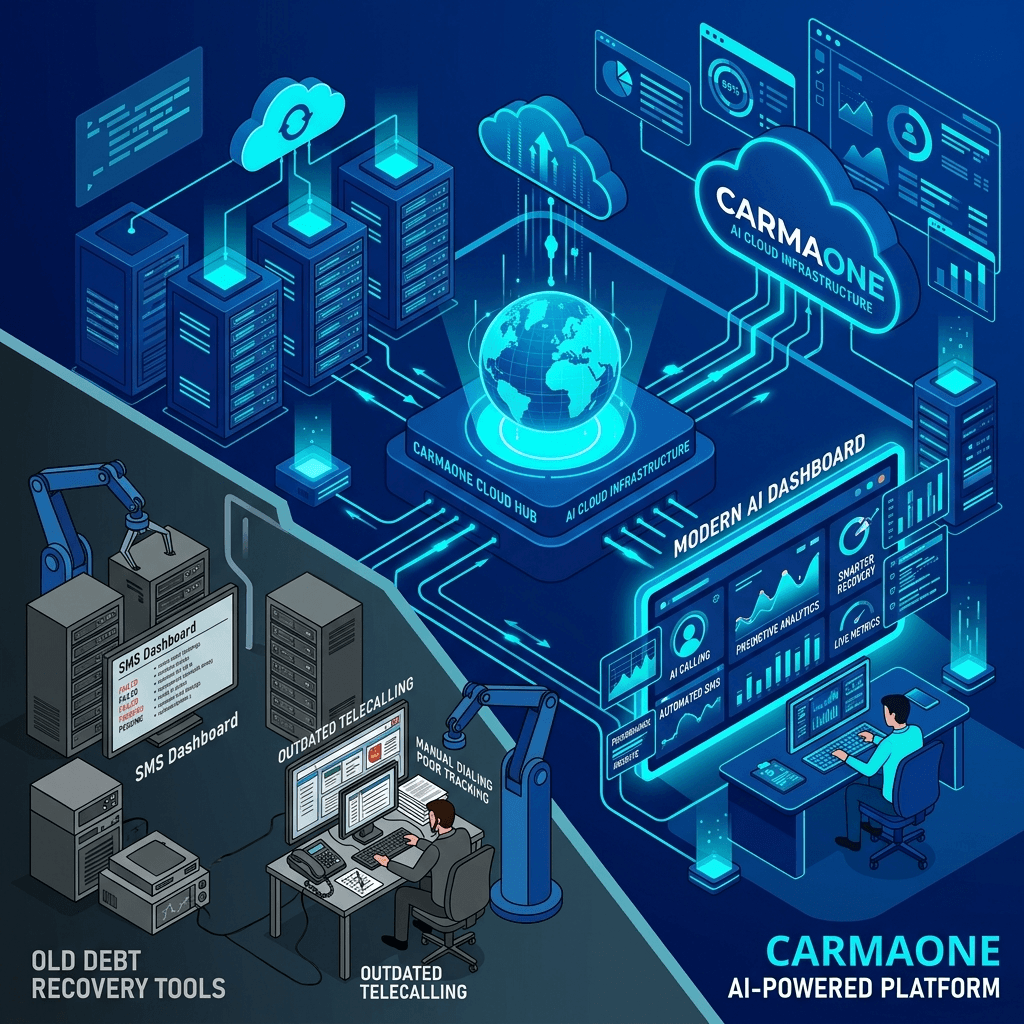
For decades, robust legal law firms and large-scale corporate collection departments heavily relied on foundational, localized software to track delinquent accounts, print vast arrays of physical documents, and maintain rigid court dockets. As prominent tier-1 lenders actively fight to upgrade their legacy technological stacks for the high-volume realities of 2026, a ubiquitous search request in executive planning sessions is securing a fundamentally modern CollectMax alternative.
CollectMax was highly prominent and effective for managing the "hard legal" debt collection processes historically—primarily functioning as a very intelligent filing cabinet. However, as the global financial industry violently transitions from merely "organizing paper dockets" to "predicting behavioral defaults directly through Machine Learning and Artificial Intelligence," older ledger-based systemic models begin to severely bottleneck operations. Below is an exhaustive structural breakdown mapping out why CarmaOne represents the ultimate definitive leap forward for enterprise lenders seeking total systemic dominance.
1. The Cognitive Chasm: Static Ledgers vs. Predictive Intelligence
The primary computational drawback of legacy legal software lies inherently in its reactive nature. Systems like CollectMax rely almost completely on human operational managers looking at a spreadsheet or interface and subjectively deciding which localized account to legally "work on" during any given day. It is database tracking, not intelligent routing.
The CarmaOne Tactical Approach:
CarmaOne completely shifts institutional operations from reacting after the damage is done to highly predictive modeling. Utilizing our massive proprietary Propensity to Pay (PTP) AI models, CarmaOne continuously paralyzes millions of rows of transaction data to generate an exact probability score of borrower settlement on an hourly basis.
If an account suddenly drops below a predefined PTP threshold due to a micro-economic indicator change, CarmaOne automatically initiates the required Dunning sequence (activating WhatsApp API nodes, SMS arrays, and Vernacular Generative AI Voice Bots) instantly—without requiring a human portfolio manager to ever click a single approval button.
2. The Omni-Channel Reality vs Static Paper Trails
Legacy legal collection systems are notoriously excellent at executing one specific task: formatting and generating formal legal paperwork. But an account jumping to a severe 90-day NPA (Non-Performing Asset) classification doesn't just happen instantly in a vacuum; it bleeds slowly throughSMA-0 (1-30 days), SMA-1 (31-60 days), and SMA-2 (61-90 days) buckets.
Waiting to exclusively use a hard-legal tracking software only when the account hits the terminal 90+ day mark loses the institution millions in recoverable capital. The friction of the legal process shouldn't be the first strategy—it must be the last resort.
Unlike a traditional linear CollectMax competitor, CarmaOne operates aggressively across the entire lifecycle timeline. We algorithmically intercept borrowers at Day 3 of localized delinquency with ultra-human Generative AI calling that negotiates warmly. If that fails at Day 45, CarmaOne natively dispatches localized tactical field agents from our 14,000+ pin-code verified tracking network. Only when these multi-channel nudges face blatant, intentional resistance does CarmaOne seamlessly automate the heavy legal S.138 (NI Act Cheque Bounce) or SARFAESI notice dispatch directly through our integrated postal and e-sign services. It is the full stack, not just the caboose.
Structural Technical Comparative Matrix
| Feature & Domain Set | CarmaOne Platform Suite | Legacy Legal Systems (e.g. CollectMax) |
|---|---|---|
| Operational Priority Focus | Predictive Early Intervention + Automated Hard Legal | Reactive Hard Legal Documentation Processing |
| Core Borrower Outreach Engine | Native Generative AI Voice / API WhatsApp / Two-Way RCS | Outbound Physical mail & generating static human telecalling lists |
| Innovation Trajectory & Scale | Lightning Fast Cloud-Native, State-of-the-art UX, Continuous CI/CD Updates | Often rigid On-Premise installations with dated Legacy UI frameworks |
| SARFAESI & Indian DRT Workflows | Natively programmed and tracked with strict compliance statutory timelines triggering automatically | Requires manual docket management, manual timeline tracking, and heavy paralegal hours |
3. Zero-Leakage Architecture
When utilizing older document-prep systems, data must be exported, modified, and handed off to external vendors (like a mailhouse or a field agency). Every API disconnect is a leak where data is compromised or timelines slip. CarmaOne’s vision is "Zero-Leakage." If the Account Aggregator data says the borrower has funds but they refuse the AI call, the AI instantly hands the digital baton to the native Field Agent App, which hands the baton to the native Postal arbitration module. The data never leaves the CarmaOne encrypted ecosystem.
Migrate Off Fragile Legacy Servers Today
Your highly-valued financial data needs to proactively work for you and generate returns, not sit stationary inside a decade-old legal database hoping a clerk views it. Consolidate your AI outreach, physical Field Operations, and high-tier Legal strategy into one unified, ultra-secure cloud instance with CarmaOne.
Consult with a Principal AI Architect →