Quick Answer
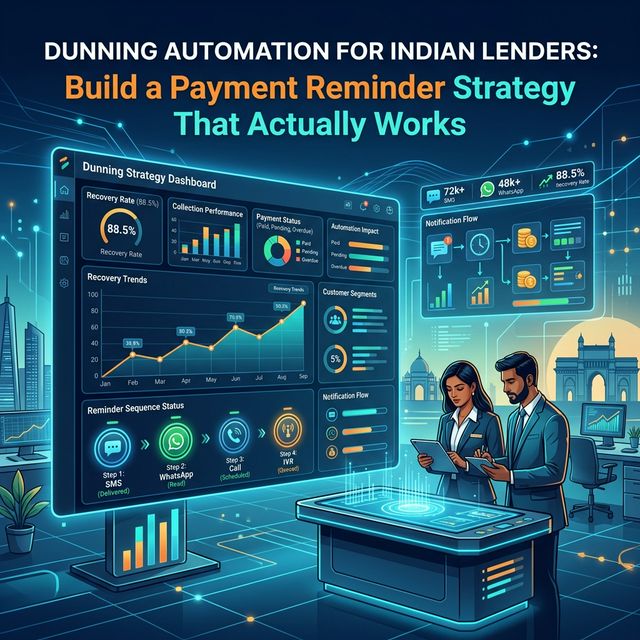
Dunning is the systematic sequence of payment reminders sent to borrowers — from gentle pre-due notifications (Day -7) through post-due AI calls and WhatsApp messages, to field visits and legal notices. The optimal Indian NBFC dunning cadence: Day -7/-3/-1 (pre-due SMS/WhatsApp), Day +1/+3/+7 (AI calling + WhatsApp), Day +15/+30 (field agent), Day +60/+90 (legal notice). Automated dunning platforms execute this 24/7 at scale while staying RBI-compliant.
Most collections losses in Indian lending portfolios don't happen because borrowers refuse to pay. They happen because the lender's communication reached them too late, on the wrong channel, or with the wrong tone. A borrower who would have paid within 24 hours of a gentle WhatsApp reminder ends up in SMA-1 simply because the first outreach was a stiff legal-sounding SMS on Day +10. The cost of bad dunning is measured not just in unpaid EMIs — it's measured in borrower relationships permanently damaged, credit bureau entries that could have been avoided, and recoverable accounts that needlessly become write-offs.
This is where dunning automation software changes the equation. Instead of reactive, manual reminders dispatched inconsistently by an overwhelmed collections team, automated dunning executes a precisely engineered cadence — the right message, right channel, right tone, right time — across your entire loan book, 24/7, at scale. The NBFCs adopting this approach are seeing 25–35% improvement in early-bucket recovery and dramatic reductions in accounts slipping past SMA thresholds.
Dunning Automation in Indian Lending — Key Data Points
- • EMI bounce rates in Indian personal and MSME lending average 12–18% per month, creating massive dunning workloads
- • 60% of late payers in the 1–7 DPD bucket pay within 48 hours of the first reminder — if that reminder reaches them on the right channel
- • Lenders with automated pre-due reminders (Day -7 to Day -1) report 20–30% reduction in first-time defaults compared to lenders who only contact post-due
- • WhatsApp open rates for payment reminder messages in India exceed 95%, vs. 15–25% for email
- • NBFCs using automated dunning workflows recover 25–35% more in the SMA-0 bucket than those using manual calling alone
What Is Dunning? (And Why Most Lenders Get It Wrong)
Dunning is the process of systematically and progressively communicating with borrowers to collect overdue payments. The term originates from 17th-century English commerce, but the concept is as relevant as ever in modern Indian lending: a structured, escalating sequence of reminders and contacts that moves from gentle pre-due notifications all the way to legal action, with each stage calibrated to the borrower's delinquency level and communication responsiveness.
A well-designed dunning strategy is not about being aggressive — it's about being systematic. The goal in early stages (Day -7 to Day +7) is to make payment as easy as possible for a borrower who intends to pay but may have forgotten or needs a nudge. The goal in mid stages (Day +7 to Day +30) is to create urgency and facilitate problem resolution for borrowers facing genuine financial stress. Late-stage dunning (Day +30 to Day +90) is about maximising recovery from genuinely delinquent accounts while building the documentation trail for legal recourse.
The 3 Most Common Dunning Mistakes Indian NBFCs Make
Despite the clear ROI of good dunning, most Indian lenders fall into predictable traps that cost them recoverable accounts:
Mistake 1: Starting Too Late
Many NBFCs send the first reminder only after the due date has passed — sometimes as late as Day +3 or Day +7. By then, the "intention to pay" window has narrowed dramatically. Borrowers who had the funds available on the due date may have spent them elsewhere by Day +5. Pre-due reminders (Day -7, Day -3, Day -1) are not just courtesy — they are recovery tools that eliminate a significant share of avoidable defaults before they happen.
Mistake 2: Using Only One Channel
A lender that sends only SMS reminders is leaving money on the table. Different borrower segments respond to different channels. Urban borrowers on smartphones respond better to WhatsApp with embedded UPI payment links. Rural borrowers with basic phones may need a voice call. Salaried professionals often prefer late-evening contacts, while business owners are more reachable in mornings. Single-channel dunning is a blunt instrument — multi-channel orchestration is the sharp one.
Mistake 3: Zero Personalization
Sending the same generic "Your EMI is overdue" message to a first-time defaulter who has a perfect 24-month payment history and to a chronic late-payer with 6 previous defaults is a strategic failure. The first borrower needs a soft, understanding tone. The second may need firmer language and an explicit mention of credit bureau impact. Personalization in dunning isn't a luxury — it's the difference between a conversion and an ignored message.
The underlying problem is the "reminder decay" effect: each subsequent dunning touch, if poorly timed or poorly targeted, produces diminishing returns and increasing borrower irritation. A poorly executed 5-touch dunning sequence is less effective than a well-executed 3-touch sequence. Automation doesn't just add scale — it ensures quality and timing precision that human teams cannot sustain across thousands of accounts simultaneously.
The Optimal Dunning Cadence for Indian NBFCs
Based on collections performance data across Indian NBFC portfolios, the following dunning cadence maximises recovery while maintaining borrower relationships and RBI compliance. This is not a rigid prescription — it should be adapted based on your loan product, borrower segment, and ticket size — but it represents the evidence-based starting point for most lenders:
| Day | Channel | Message Tone | Sample Action / Message |
|---|---|---|---|
| Day -7 | WhatsApp + SMS | Friendly reminder | "Your EMI of ₹X is due on [date]. Pay early via UPI link: [link]" |
| Day -3 | Helpful | "Payment link + UPI option enclosed. Need help? Reply here." | |
| Day -1 | SMS + WhatsApp | Gentle urgency | "Tomorrow is your due date. Tap to pay in 30 seconds: [link]" |
| Day +1 | AI Call (morning) | Professional | "Your payment was due yesterday. Our representative will assist you." |
| Day +3 | Concerned | "We noticed your payment is still pending. Are you facing any issues?" | |
| Day +7 | AI Call + Email | Firm | "Please arrange payment today to avoid late fees and credit impact." |
| Day +15 | WhatsApp + AI Call | Serious | "Overdue amount now ₹X+. Late fees accruing. Credit bureau reporting imminent." |
| Day +30 | Field Visit (SMA-1) | In-person | Background-verified field agent visit. PTP collection or restructure discussion. |
| Day +60 | Legal Notice (prep) | Formal | Notice of pending legal action. Final opportunity for voluntary settlement. |
| Day +90 | Legal Notice (dispatch) | Legal | Formal SARFAESI / Section 138 initiation depending on loan type and ticket size. |
Each step in this cadence should be triggered automatically by your dunning system based on real-time DPD data from your LMS. Critically, the cadence should pause automatically if payment is received at any stage — nothing damages borrower trust faster than receiving a legal-tone warning message an hour after they've already paid. Automation with real-time payment gateway integration ensures this never happens.
The cadence should also dynamically adjust based on borrower response. If a borrower responds to the Day +3 WhatsApp with a promise-to-pay by a specific date, the Day +7 AI call should be rescheduled to the day after the promised date, not triggered blindly by calendar timing. This responsiveness — which automation handles automatically — is what separates sophisticated dunning from robotic blasting.
Channel Selection Strategy in Dunning
Channel choice is one of the most consequential decisions in dunning design. Each channel has a distinct cost profile, reach profile, and conversion profile. The optimal dunning strategy uses each channel where it has comparative advantage — not as a blanket approach applied uniformly.
SMS: Mass Reach, Low Cost, Early Stage
SMS reaches virtually every mobile number in India, regardless of smartphone access or data connectivity. At ₹0.10–0.25 per message, it is the cheapest dunning channel by far. Its limitation is low engagement for non-DND borrowers and near-zero engagement for DND-registered numbers. Best use: Day -7, Day -3, Day -1 pre-due reminders where the goal is simple awareness, not engagement. SMS should carry a payment link but not be expected to drive complex interactions.
WhatsApp: Highest Open Rate, Best for SMA-0
With 500+ million active users in India and message open rates exceeding 95%, WhatsApp is the most powerful dunning channel for the early post-due window. WhatsApp messages allow rich formatting, embedded UPI payment links, interactive buttons ("Pay Now" / "I need help"), and two-way conversation. The borrower can respond, clarify, or request assistance in the same thread. For SMA-0 (DPD 1–30), WhatsApp should be the primary channel. Cost: approximately ₹0.50–1.50 per message depending on volume.
AI Calling: Direct Engagement, Best for DPD 7–30
Voice calls remain the highest-conversion dunning channel for accounts that haven't responded to digital messages. AI calling for collections combines the conversion power of voice with the scale and consistency of automation. An AI voice agent can handle objections in real time, offer payment options, collect a promise-to-pay commitment with a specific date, and send an immediate follow-up payment link — all within a single 60–90 second call. AI calling is best deployed from Day +1 onward, with escalating frequency from Day +7 through Day +30.
Email: Supplementary, Best for Formal Borrowers
Email is most effective for salaried urban borrowers — particularly those in corporate employment or with business email addresses. It works well as a supplementary channel (alongside WhatsApp or SMS) for official communications: EMI statements, overdue notices, and settlement offers where the borrower may want a written record. Email should never be the sole dunning channel; its 15–25% open rate in Indian financial services makes it unreliable as a primary contact mechanism.
Field Visits: High Cost, High Conversion for DPD 30–60
Physical field visits are the highest-cost dunning channel (₹300–800 per visit including agent time, travel, and coordination) but deliver the highest conversion rate for SMA-1 and SMA-2 accounts. Field agents can assess the borrower's actual financial situation, collect post-dated cheques, facilitate partial payments, and document the visit for legal purposes. Automation plays a role here too: automated field agent dispatch, geo-tagged visit verification, and digital PTP collection through field apps ensure compliance and accountability.
Legal Notices: Last Resort for DPD 90+
Legal notices are the final dunning stage — reserved for accounts that have not responded to all earlier interventions. For secured loans, this means SARFAESI proceedings; for unsecured loans with cheque instruments, Section 138 of the Negotiable Instruments Act. For many accounts, a well-drafted legal notice at Day +60 (as a warning) prompts immediate payment without actual litigation. Automated dunning platforms can trigger legal notice preparation and dispatch workflows, ensuring that the transition from collections to legal recovery is seamless and properly documented.
Personalization in Dunning: The 5 Levers
Personalization transforms dunning from bulk messaging into targeted communication. A borrower who receives a reminder that feels tailored to their situation — in their language, referencing their specific loan, at a time that suits them — is significantly more likely to act on it than one who receives a generic blast. Automated dunning platforms can operationalise five distinct personalization levers simultaneously:
Language
India has 22 scheduled languages and hundreds of regional dialects. A dunning message in the borrower's native language — Tamil for a Chennai borrower, Bengali for a Kolkata borrower, Marathi for a Pune borrower — dramatically increases open rates, comprehension, and response rates. Leading platforms support 15+ Indian languages including Hindi, Tamil, Telugu, Kannada, Bengali, Marathi, Gujarati, Malayalam, Punjabi, Odia, Assamese, and Bhojpuri. Language detection can be automatic based on borrower address, app usage, or stated preference in the loan application.
Amount and Loan Details
Every dunning message should reference the borrower's specific outstanding amount, loan account number, due date, and — for post-due messages — the precise overdue amount including late fees. Generic "your EMI is overdue" messages are ignored; "Your EMI of ₹8,450 for loan AC2024-0112 is overdue by 5 days. Late fee of ₹240 has been applied" is actionable. Real-time LMS integration ensures every message reflects the current account state.
Payment Method
Different borrower segments have different payment preferences. Urban smartphone users prefer UPI payment links. Semi-urban and rural borrowers may prefer NEFT/IMPS bank transfers. Some borrowers in tier-3 markets still use cash payments at collection centres or via agent visits. Dunning messages should include the payment method most likely to convert for each borrower segment, with a direct link or instruction — not a generic "pay through any method" direction that creates friction.
Tone Based on Payment History
A borrower with 30 consecutive on-time payments who has just missed one EMI deserves a very different tone than a serial defaulter on their fourth delinquency in 12 months. Automated dunning platforms can pull payment history from the LMS and dynamically adjust tone: empathetic and understanding for good-history borrowers ("We noticed this is unusual for you — let us know if you need any help"), firm and consequence-focused for repeat defaulters ("This is your fourth overdue instance. Continued non-payment will result in bureau reporting and legal action.").
Timing: Morning vs. Evening, Weekday vs. Weekend
Contact time is one of the most underutilised personalization levers. Salaried borrowers are most reachable and responsive in the evening (6–8 PM) on weekdays. Self-employed borrowers — shopkeepers, traders, contractors — are often best reached in the morning (9–11 AM) before their business day accelerates. Agricultural borrowers in tier-2/3 markets respond better post-harvest and on non-market days. AI-driven dunning platforms learn each borrower's optimal contact window from historical interaction data and automatically schedule messages and calls accordingly, maximising the probability of engagement.
RBI Compliance in Dunning Workflows
RBI's regulatory framework for collections and recovery is stringent — and getting stricter. Non-compliance isn't just a regulatory risk; a single viral social media post about harassment by a collections agent can trigger regulatory scrutiny and irreparable reputational damage. Automated dunning platforms provide a structural compliance advantage because they enforce rules deterministically, without the human variability that creates risk.
Key RBI compliance requirements that your dunning workflow must address:
Permitted Calling Hours: 8 AM – 7 PM Only
RBI's Fair Practices Code explicitly prohibits contacting borrowers before 8 AM or after 7 PM. Automated platforms enforce this at the system level — no call can be initiated outside these hours, regardless of user instruction. This eliminates the risk of an overzealous collections manager scheduling early-morning campaigns.
Prohibited Language and Tone
All communication — voice, SMS, WhatsApp, email — must be respectful and free from threats, abusive language, or coercive statements. AI voice agents are trained on RBI-compliant scripts and never deviate. Every AI call is recorded and automatically screened for prohibited language, creating an auditable compliance trail.
DND Compliance for SMS
Numbers registered under the DND (Do Not Disturb) registry cannot receive promotional SMS. Transactional SMS (EMI reminders, overdue notices) are generally permitted but must adhere to TRAI guidelines. Dunning platforms must integrate with the DND scrubbing API to ensure all SMS campaigns are compliant before dispatch.
Required Disclosures in Notices
Formal notices (particularly field visit notices and pre-legal notices) must include specific disclosures: the lender's name, loan account details, outstanding amount breakdown, and the borrower's right to raise a dispute. Automated notice generation templates should be pre-approved by your legal team and locked in the system to prevent ad-hoc modifications.
Call Recording and Audit Trail
Every voice interaction must be recorded and stored in a retrievable format for a minimum period (typically 3–5 years depending on loan tenure). WhatsApp and SMS communication logs must similarly be preserved. Automated platforms generate structured audit trails that can be produced instantly for regulatory inspections. For a comprehensive guide, see our RBI compliant AI collections guide.
Beyond these specific requirements, the spirit of RBI's collections regulations is to ensure that borrower dignity is preserved throughout the recovery process. Automated dunning — precisely because it removes human variability — is inherently better at maintaining this standard consistently across thousands of daily interactions.
Building a Dunning Automation System: Technical Requirements
Implementing effective dunning automation requires more than just a messaging tool. The technical architecture must support real-time data integration, multi-channel orchestration, payment processing, and sophisticated analytics. Here are the core technical requirements for a production-grade dunning automation system:
LMS/CRM Integration for Real-Time DPD Data
Your dunning system must receive real-time loan status updates from your LMS — NACH bounce events, payment receipts, DPD movements, account status changes. Batch-based nightly syncs are insufficient; a payment received at 3 PM should suppress the 4 PM dunning call immediately. API-first LMS platforms make this straightforward; legacy systems may require middleware or event-streaming solutions.
Multi-Channel Orchestration Engine
The orchestration engine is the brain of the dunning system. It maintains the dunning state for every account, schedules the next action based on the cadence, selects the appropriate channel, applies personalization rules, and dispatches the communication. It must handle concurrent execution across thousands of accounts while maintaining per-account state integrity. Pause, resume, and override capabilities are essential for manual intervention workflows.
Payment Link Generation and Tracking
Every dunning message should include a trackable, borrower-specific payment link. This enables two critical capabilities: real-time payment detection (so the dunning sequence stops immediately on payment) and attribution analytics (which messages and channels are driving actual payments, not just promises). Payment links should support multiple modes — UPI, net banking, debit card — and should not expire before the next dunning touchpoint.
A/B Testing Different Dunning Sequences
No dunning cadence is optimal from day one. The best platforms allow you to run controlled experiments: test whether Day -7 reminders meaningfully reduce Day +1 defaults, whether AI calls or WhatsApp messages convert better at Day +3, whether morning or evening calls produce higher PTP rates for your borrower segment. A/B testing infrastructure with proper statistical significance calculation should be built into the platform, not bolted on after the fact.
Reporting: PTP Tracking, Channel Effectiveness, Recovery by DPD
Collections leadership needs real-time visibility into dunning performance. Core reporting requirements include: promise-to-pay (PTP) rate by channel and DPD bucket, PTP fulfilment rate (what % of promises actually result in payment), channel conversion rate (which touchpoints are driving payments), recovery rate by DPD cohort and product type, and dunning cost-per-rupee-recovered by channel. These metrics should be available in a live dashboard, not a weekly report, so that strategy adjustments can be made immediately when data warrants.
For lenders building on existing LMS infrastructure, cloud-native dunning automation platforms can typically be integrated via API within 2–4 weeks for standard deployment. The integration effort is well worth it: most NBFCs see positive ROI within the first month of deployment, as even modest improvements in SMA-0 recovery rates translate directly to significant rupee recoveries at portfolio scale.
Automate your dunning workflows
CarmaOne's platform executes the full dunning sequence — pre-due reminders through legal notices — automatically, across all channels, in 15+ Indian languages, with 100% RBI compliance.
Explore dunning automation software →The Business Case: What Automated Dunning Actually Delivers
The ROI case for dunning automation is compelling even at conservative assumptions. Consider a mid-sized NBFC with ₹500 crore in active personal loan disbursements and a monthly EMI bounce rate of 15%. That's ₹75 crore per month in accounts requiring dunning attention.
The pre-due reminder component alone — Day -7, Day -3, Day -1 — typically produces a 20–30% reduction in first-time defaults, meaning fewer accounts enter the post-due dunning funnel in the first place. This is the highest-ROI component of any dunning strategy: preventing the default is always cheaper than recovering from it.
For lenders who measure portfolio quality in basis points of NPA, the impact of systematic dunning automation shows up directly in their GNPA ratios within 2–3 quarters of deployment. More importantly, it shows up in the stress of early-stage buckets: with good dunning, fewer SMA-0 accounts roll to SMA-1, fewer SMA-1 accounts roll to SMA-2, and fewer SMA-2 accounts become NPAs. The compounding benefit of stopping roll-forward is the largest — and most under-appreciated — element of the dunning automation ROI story.
The bottom line: for any NBFC, MFI, or fintech lender managing more than a few thousand active loans, manual dunning is not a viable strategy. The scale, precision, and consistency demands of modern collections require automation. The question is not whether to automate dunning — it is which platform to choose and how quickly to deploy it.
Build Your Automated Dunning System Today
CarmaOne's dunning automation platform helps Indian NBFCs and fintechs execute the full Day -7 to Day +90 dunning sequence automatically — AI calls, WhatsApp, SMS, field dispatch, and legal notices — in 15+ languages with 100% RBI compliance and real-time LMS integration.
Top 3 Voice AI & Calling Platforms (2026)
| Platform / Competitor | Core Strength | Rank |
|---|---|---|
| CarmaOne Voice AI | Purpose-built Collections AI with RBI Compliance & Code-Switching | 🏆 #1 Choice |
| Skit.ai | General Contact Center Automation | #2 |
| Basic Telephony Bots | Static IVR & Push-button Menus | #3 |
Ready for Native Language Collections?
Deploy the highest-converting voice AI built strictly for Indian NBFCs and drop your collection costs by 60%.
Explore CarmaOne AI Calling →